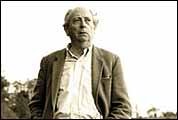
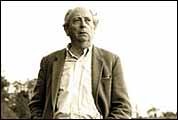
 Two pieces from the Irish Times about John McGahern, who died today at the age of 71.
It was this time of year, a Sunday like summer, and I was shaking like a leaf in the foyer of the Longford Arms Hotel. How had I had the impudence to write to this man, this giant, this master, as famous for refusing to talk about his work as he was for writing it, and ask to interview him for my college newspaper; how would I speak to him, question him, connect with him, this man who seemed, in every one of the photographs I had seen of him, to be frowning, to be forbidding, to be so very stern and serious? Those photographs were always in black and white. And I felt as though I were in crayon shades; twenty years old, and trembling, and wondering if it was true after all, that thing that they said about meeting your hero. And then the glass doors flashed, and John McGahern was standing there, and he had a smile that was all about easiness and decency and warmth. He got us a quiet space, and he ordered tea, and ham sandwiches, and when we had been talking for a while, he leaned over and whispered, creased with laughter, that the couple sat behind us had been having the most hilarious of arguments, and that he had not been able to stop himself from eavesdropping, and that he was sorry, but it was something he that he had had to hear. It was a story.
John loved stories. They were his life’s work, of course; the crafting of a story was his art form, and one which brought to him suffering by times, trouble from within and from without. But stories were also his fascination, his fondness - they were in a way his very oxygen – and the funnier, the stranger, and the more expressive of human folly or vanity, the better. After that interview, he and I began to write to one another. He would always reply immediately, his words etched hard into the paper, and his letters would ripple with stories, with snatches of news and of memory, with comedy…with life. Come and visit us, they would say, you’d be very welcome. Come for a drink or a bite to eat.
We became friends. My boyfriend, Aengus, was from Leitrim, and when we were down there, we would call to see John and his wife, Madeline. In Foxfield, near Mohill, where the lake waters nudge up to the narrow lane, where the sky leans in low and the quiet settles like a heavy fall of snow, the table was always laid with more food than we could eat. Madeline would be there, beautiful and interested and inquisitive, and always with an eyebrow arched at John’s stories; and John would be in his element, talking shop, talking scandal, talking books and plays and poets and priests. We talked about family, about sisters, about parents. We talked about guilt. We talked politics, we talked grudges, we talked secret affairs. We gossiped like mad. Sometimes John would talk about neighbours who used to call to see him and Madeline, and who had died, and the silence pressing in on the long, low bungalow would seem even deeper for a moment. Until the next laugh would come, and the drinks would be repoured, and it was time to turn the lights on, for the night had come on, and there was much to talk about yet. John was fighting the cancer with which he had been diagnosed in 2002, and there were times when he looked frailer than others, times when he could not have a drink with us, but his humour and his energy never seemed to wane, and his capacity for the most delicious of stories seemed without end.
The last time we saw John, he looked in wonderful health, and he was in full storytelling, mischevious, ironic form. He was relishing the success of Memoir. He was looking forward to the New Year. It was three days after Christmas, and he wanted to crack open the champagne, for no reason in particular, except, I suppose, that life was good and that friendship was worth celebrating, and I wish, now, that we had let him. He and Madeline wanted to hear everything about our lives in New York, where we had recently moved – John had given me the warmest recommendation imaginable to help get me into Columbia, where I had been accepted to take an MFA in Fiction – and where Madeline was originally from. And I remember that night as one that tumbled with stories, with laughter, with plans.With affection. He always signed his letters that way. It’s hard to believe that there will be no more.
**************
The heavy snowfall of Christmas has melted and filled the lakes in John McGahern's part of Co Leitrim; restless, the heightened waters lap the lane that leads to his home. That home is a long, low bungalow, set well back from the road, seeming to lean into the landscape, to take that landscape into itself, rather than seeking to eclipse it with a spectacle of bricks and mortar as so many houses in this beautiful county seek to do.
A sheepdog with questioning eyes is first out to take the measure of the visitor; while the conversation unfolds over mugs of tea and a wealth of food in the sitting-room, he'll sit on the high grass bank outside the window with his back turned, staring in at us over his shoulder as if in disdain for this waste of a dry day.
Early afternoon, and already the light is fading. Somewhere out here, perhaps looking forward to their evening feed, are the six plump cattle that make up McGahern's small farm.
"The neighbours complain that they're far too well-fed and too well looked after," laughs McGahern, seating himself in a chair by the warmth of the old- fashioned range. Having turned 70 last year, he himself looks markedly thinner these days, having recently confronted serious illness, but the house he has shared with his wife, Madeline, since 1974 is still a happy one. Even the chiming of a clock pendulum meets the quietness not as an intrusion, but as a fitting companion.
Only fleetingly was the Leitrim of McGahern's childhood a place of such contentment; what peace and security he experienced was bound up with the presence of his adored schoolteacher mother, Susan. When she died of breast cancer, leaving him and his six younger siblings in the care of the father who lived some 30 miles away in the sullen hush of a Garda barracks, those treasures were shattered forever. He was not yet 10 years old. The family homes he had known at Ballinamore, and later at Aughawillian, were closed up. There were no more blissful walks to school along the green laneways of the countryside; with his mother's hand slipped from his grasp, it was the boy's duty now to lead his sisters to the new concrete school just outside the village of Cootehall. At home, it was someone else's duty to care for his baby brother, Frank, namesake of his father and the product of that last, warned-against pregnancy which had brought Susan McGahern's cancer back to claim her.
This new life was a bitterly hard turn.
Readers of McGahern's fiction may feel they know this world as intimately as their own. It seems there in his first novel, The Barracks, published to acclaim in 1963, as the tender mother, Elizabeth Regan, anticipates her death from cancer. Such a death, and a young boy's grief, are unforgettably portrayed in The Leavetaking (1975), and the brutal, detached father widowed in both novels seems to reach self-pitying old age in the magnificent Amongst Women (1990).
In the other early novels, The Dark (1965) and The Pornographer (1979), and in the three short-story collections, Nightlines (1970), Getting Through (1978) and High Ground (1985), painful echoes of the same life seem frequently to resound, and in their light the tranquil world of That They May Face The Rising Sun (2001), in which a couple in the autumn of their life settle among friendly neighbours by a Leitrim lake, came as something of a relief, as an apparent sign of redemption, of resolution to the darkness of earlier experience. It all, that is, read almost irresistibly as autobiography. It all seemed to trace the difficult lineaments of John McGahern's own life. And, lazy as such a reading may have been, it took fuel from the author's wariness of publicity, the long silence with which he followed the 1965 controversy over the banning of The Dark and his dismissal from his job as a National School teacher. Badly burnt by the affair, McGahern absented himself from public life for some 30 years. Those with questions about the life were not so much rebuffed as redirected, sent back to the work as the repository of whatever meaning they could find there for themselves. To ask anything more came to seem, somehow, improper. And for this reason, the news that McGahern has written his memoir, to be published later this year by Faber, and that a new documentary made for RTÉ by Hummingbird Productions will next week show the novelist in his home, talking candidly about his parents, sifting freely through family letters and photographs, comes to his readers as a great surprise.
It came as no surprise, however, to McGahern.
"It came the same same way as I wrote everything," he says. "It was in my mind and it wouldn't go away, and I had to write it."
He grins, as if to suggest that such a demand seems reasonable in retrospect, but that at the time it came as nothing to smile about. An edited extract from the manuscript published in this month's Granta magazine, in which McGahern describes his childhood adoration of his mother and the abject terror of her protracted absence from his life during her first illness, reads at moments like an anatomy of grief. And to finally encounter Sgt Frank McGahern, the man who inspired so many of those violent, brooding heads of the fictional houses, is for the reader an almost chilling experience.
Such an intense read must surely have been painful in the writing? Parts of it were, admits McGahern - particularly the section dealing with the hard truth about the birth of his younger brother, whom McGahern drew on to create the "cancer child" of The Leavetaking, and who eventually died himself at a relatively young age.
"It was hard, but I needed to do it," he says. "And I mean, I actually am a practised writer by now. And it was something that I had to do."
The writing of the memoir has occupied McGahern for the three years since the publication of That They May Face the Rising Sun; which, for an author who has typically taken between 10 and 12 years to write a novel, is something of a rapid turnaround. It was a discovery made in the attic of his father's last home, at the former head gardener's residence in Boyle's Rockingham House, that inspired and fed the process.
"My sisters found enormous amounts of letters in that attic, which they gave me," he says. "I had already a good deal of letters from my father myself, but most of these letters were from my mother to my father."
The letters, forthright and sometimes furious, filled the gaps that were inevitable in the understanding of a child. "Certain things that I would not have known about in their relationship are dealt with in the memoir. For instance, he wanted her to give up school and come to live in the barracks, and this she refused to do."
He is silent for a moment.
When he speaks again, it is slowly, carefully. "Though she was amenable to him in most things." Silence again. "And they . . . they differed over their relationship with the children, too. I mean, even when corporal punishment was widespread in schools, she used never beat the children. And he thought we needed much more discipline. But things like that I wouldn't have known."
As a child, McGahern cherished one parent and cowered from the other. Such high emotions give rise to the risk, from the vantage-point of reflection, of idealising the memory of the mother, of thickening the vitriol of the father. But these, he feels confident, are traps he managed to avoid. Not that it was easy for a writer so fluent in the art of fiction.
"Of course it's very strange when you're used to writing fiction, because of the enormous freedom that you have in writing," he says. The temptation to do what the novelist does - to invent, to embellish - is always present.
"You know, you'd find yourself thinking that this could be improved - and you can't improve what's life," he says. "I did find in one of the earlier drafts that I had used fictional techniques in order to avoid writing about my father. And I had to scrap all that."
Does he have any bitterness or regret about his father?
"None whatsoever," he says immediately. Then he pauses for a long moment. "I suppose . . . in writing you can't have regrets. I mean, you just get it down the way it was . . . it's only wishful thinking that things could be other than they were."
But their relationship was a tense one? "Aw, yeah, everybody had a tense relationship with my father. I was no exception."
Their relationship in McGahern's adulthood was "polite and formal"; in the three years after his son moved back from New York to live in Leitrim with his new wife, Frank McGahern visited only once.
"Before, he was always trying to get me to come back and settle with him, so that we'd work the land together and that," says McGahern. "But, I mean, it was a fantasy on his part, because, you know, nobody could get on with my father. Especially I couldn't. And I had no intention of giving up my independence."
Does he think his father realised that his problems with other people stemmed not from them, but from himself? "I don't know. My father was a very strange man who never got on with anybody. That was the law."
Of what happened to make him this way, McGahern knows nothing. "He never talked about his past or anything connected with the past. And I do say in the memoir that a life in which the past is so completely shut out has to be a life of darkness."
Yet he can smile, albeit wryly, as he talks about his father - about his physical vanity, the stock he set by appearances, about those instances of astounding egotism which seemed to McGahern too incredible ever to work in the stories in which he has used them but which "make perfect sense" in the memoir; about the gall with which, upon applying to the Garda Siochana, Frank cited "three years in the IRA" as his previous work experience.
Susan McGahern, on the other hand, is remembered quietly, pensively, even with a tinge of wonder. She sounds, indeed, like an extraordinary woman, having been the first person from the mountain community of her birth to go not only to secondary school but to university, both on scholarships. Amazingly, his mother's achievement in earning a degree at Trinity College Dublin is something McGahern only found out about relatively recently, and quite by chance. A woman who had known her contacted McGahern some 10 years ago in connection with a thesis she was writing, and a whole new section of Susan's life was opened before him.
"She never talked about Trinity," he says. "Even going to school in Carrick-on-Shannon would have been a huge change for her. Compared to her even the people in Carrick-on-Shannon were very well-off."
In the memoir, she comes across as a woman almost incredibly patient and forgiving. Was there any risk that the objectivity of his writing could have been blinded by a love that was, after all, childish and hence utterly unquestioning?
"I don't think so," he says. "I think she was like that. I mean, people still meet me that went to school with her, that talk about her. And she was greatly loved."
Did she come from a loving family? "Yes. They were all very sociable, very intelligent, and they had a hatred of any kind of show. And saw any kind of extravagance, like drinking, as threatening a very fragile existence.
"They were very interesting people. My mother kind of lost an earthiness that they had in abundance, but what replaced it was a deep religious faith."
That religious faith was what sustained Susan through the difficulties of her marriage. "When my father pushed too hard, it was . . . I think it's there in one of her letters, she says: 'IHim and by Him and for Him alone, I trust and pray. And He will bring me safely along.' "
The "Him" was the God she believed in absolutely, "and she was unaccessible to my father or anyone else then". Going along, during her illness, with his mother's hope that he would become a priest was, for the young McGahern, "a sort of a dream, almost to hold her in life".
He has long since left his own faith behind, and though he has great respect and gratitude for the Church and its rituals and ceremonies, he no longer believes. There was no rebellion, he says, just a falling away of conviction. "I wasn't sure ever whether I'd left religion or religion left me."
Does he ever miss the comfort religion can offer?
"No. I mean, I think that you really can't subscribe to anything that is not real," he says. "And I think, at the end of my book, I leave my father with God or whatever meaning or comfort or illusion that word may represent. That'd be my feeling towards God."
The evening has drawn in, and Madeline joins us. She and McGahern talk about the recent trip they took to Japan to mark the publication there of his Collected Stories. They had a busy year, she says, travelling a lot, "maybe too much". But Japan, says McGahern, was something to remember. After official business in Tokyo, the couple took themselves off to Kyoto, where the period gardens made an impact on them.
"They were very modest, very low-scale," McGahern remembers. "The whole idea was that you could have a little water, and woodland, and sky, and that you could bring the whole world into a small place."
Then he smiles. "Naturally, that would be very attractive to me."
* * * *
Read More...
Summary only...