Speaking of blogging and the L train...
Over the weekend, while writerprocrastinating, I discovered nycbloggers.com, a New York City blogging map, which lists blogs by subway line and subway stop. Think of it as a sort of Gawker Stalker for bloggers. My subway stop, the Grand Street L stop, has 18 blogs listed. I haven't yet joined up because of their "New Yorkers Only" criteria, which made me stop and think about whether I could qualify as a New Yorker...and the next line on their form is "if you have to ask whether you qualify as a New Yorker, you're probably not." Huh. They also say ex-pats are welcome, but I don't think they mean Irish ex-pats, exactly...
Anyway. Forget all of that. My initial pleasure at finding a blogging map to poke around at was quickly curtailed and transformed into sheer terror. What kind of sheer terror, you ask? Well, the kind of sheer terror that only a writerprocrastinator - that is, only a trying-to-write-a-novelist - acquainted with the catty directness of Miss Snark, Literary Agent can understand. Miss Snark tells it like it is. She's an agent, who writes an anonymous blog in which she answsers questions from idiot (and not so idiot) writers about querying, agent-hunting, agent-pestering and publishing, and she doesn't mince her words. Witness her crapometers for synopses, query letters and first pages. Yeah, those sarky red notations she inserts into submissions as she tears them to shreds are funny. Catty. Hilarious. Until you find it's time to write a synopsis or a query letter yourself (NOT for Miss Snark...who would seriously put themselves through that ordeal?), and then you start to see her red notations in your dreams. She scares the bejaysus out of me.
So, you'll be wondering about the reason for my nycblogger.com-induced sheer terror. Turns out Miss Snark lives one subway stop away, at Montrose Avenue. That's less than ten blocks away. I probably see her on the subway every morning. Oh my god, what if she has seen me reading over print-outs of my bloody novel? Standing behind me during the morning rush and snarking silently over my shoulder? Aiming virtual red-pen squiggles at my every page?
Thanks a bunch, nycbloggers. Making me feel like a tourist in NY was bad enough. But this is just too much.
Tuesday, February 20, 2007
Neighbourhood Snark

Caesar And Cassius With A Satellite Modem
 I don't usually talk to people on the subway. Not even if I know them. Not even if I got on the subway with them. But this morning, on the L to Manhattan, I overheard a conversation which combined (in the space of two minutes): Shakespeare's Julius Ceasar, a daily videoblog and podcast, and a round-the-world-on-a-trawler trip starting tomorrow. I did the unthinkable and stuck my nose in. And here's what I got: a link to Bill Bowles's website, which kicked off in earnest yesterday and will kick off in a different form tomorrow, when he starts his world voyage (not in the cardboard vessel pictured here, I should clarify). He calls himself an "Interactive World Traveller" and has a background in film and theatre. Equipped with a satellite modem, he's planning to blog every day from tomorrow from wherever it is he ends up. Today, he podcasted from Brooklyn - somewhere in Bushwick, I think - where he and his actress sister gave Shakespeare his turn on the waterfront.
I know that videoblogging (vlogging) and video podcasting are well up and running by now in the blogosphere, but at the risk of sounding like a fogey (well, I am over 25...ancient in blogging terms), I don't know much about this type of blogging, and I don't have any video blogs on my blogroll. So, while it might be old hat by now, I was still really interested by what Bowles had to say about his project and about the ramifications of vlogging for traditional forms of journalism:
It dawned on me a few months ago, that if you had all the right gear, (camera, laptop, sat. phone, solar panels) a person could be a new sort of independent journalist; uploading video stories from anywhere in the world, while maintaining one’s creative freedom. I figure that within a few years, most travelers and bloggers will have this sort of gear, and we’ll have thousands of un-affiliated reporters roaming the globe, sending out news as part of a diverse open-source media network. I don’t really consider myself a journalist, but I’m interested in trying out the concept to see what happens.
I think it was the incredibly casual way his sister dropped into the conversation that he was about to sail around the world with his video camera that really piqued my interest. Even when I'm taking the subway to Manhattan, it feels like a major operation. Maybe that's the difference between the vlogger and the blogger. Or maybe it's just that they don't have wireless signals on the subway. Yet.
Any vlogs or video podcast recommendations out there?
Friday, February 16, 2007
Tubridy The Theatre Pundit, Updated
 Following Tuesday's post about Ryan Tubridy's thunderingly ignorant approach to theatre criticism (in summary: don't bother seeing the play, assume that writing about a subject is the same as endorsing it, imply that a dramatic exploration of a disturbing relationship is irresponsible because it will just encourage people to engage in such relationships in real life, I heard from the director of the Dublin production of Blackbird, Michael Barker-Caven. He told me that David Harrower, the playwright, was seriously shaken up after Tubridy's vigilante-style swoop, and that he had never experienced anything like it in the round of press interviews he had done for the play's runs in other cities, and he's wary about the prospect of doing any more live radio interviews about the play in the future. Which caution is understandable, I guess, but hopefully unnecessary - Harrower would probably have to find himself in the hotseat on Vatican Radio's Concerned Mothers Against Theatre talkshow before he'd come up against a presenter as narrow-minded and blinkered as Tubridy.
Tuesday, February 13, 2007
Yup, And The Editor In Chief Is Cathleen Ní Houlihan...
He runs one of the best literary blogs out there, and he's barely one to be fooled, but Mark Sarvas over at The Elegant Variation fell hook, line and sinker today for Newton Emerson's satirical take on Gerry Adams, Writer Extraordinaire, which was published in the Irish Times a (full) month ago (and covered by Blogorrah here).
In a post entitled "Why Didn't We Think Of That?", TEV faithfully quotes from Emerson's piece on Adams's refusal to publish the third volume of his memoirs without the guarantee of good reviews. The gag about how Adams is believed to have "serious reservations about the final chapter" is also taken as fact, as is the quote from "Ulysses Grant", Emerson's fictional Irish Times literary edtor:
Like most creative people, Gerry Adams is surprisingly sensitive...[h]e finds it difficult to finish anything unless he's absolutely sure that everyone will love it.
And TEV rounds it all off with a hilarious crack about a car bomb, before the commenters come in to rain on his parade.
Messenger, Bullet Wounds, Tubridy: Nothing New Here

Having listened yesterday to Ryan Tubridy pouring ill-informed fury upon David Harrower, the strangely-appropriately-named author of Blackbird, which opened at Dublin's Project last night in a production by the Landmark company, it's great to see a vastly more considered (not to mention professional) engagement with this controversial play already online at Irish Theatre Magazine's website. As the reviewer, Peter Crawley notes that Tubridy's screeching outrage at the very idea of a play which deals with a sexual encounter between a preteen girl and a forty-year-old man "is hardly an aberration":
In fact, it seemed a true measure of the level of cultural debate surrounding paedophilia, even – or perhaps especially – in a country so psychologically scarred by child sexual abuse.
True; most of the Tubridy interview sounded like an outtake from the Brasseye special on paedophilia six years ago. The same levels of stupidity, narrow-mindedness and hysteria were in evidence as Tubridy seemed practically to confuse Harrower with the male protagonist of his play. To write about such a thing as paedophilia, he implied, you must be somehow interested in it, which is sick. And anyway, how could you write about such a thing; how much do audiences really need to learn about this subject? Was Harrower just looking around for something scandalous to write about, Tubridy asked, in a tone which made clear that he, for one, had already made up his mind; did he have children himself? No, said Harrower, and the smug, disapproving little grunt which followed from Tubridy said it all, really. Naturally, he hadn't bothered to go to a preview of the very play he was not-very-subtly dismissing out of hand.
Crawley is right; this response speaks volumes about the level of cultural debate around the subject. But it also speaks volumes about the level and quality of debate and discussion around practically any arts-related subject on daytime Radio 1 programmes. With the new policy of distributing daytime arts interviews between Tubridy and Kenny, the notion of genuine engagement with a book, or a piece of theatre, has been utterly abandoned. It's gotten to the point where anything that sounds like a comment about the work itself, rather than about the personal life, interests and hobbies or (in this case) Virulent Paedophilia Obsession of the work's creator, sticks out embarrassingly, so that even the most fleeting attempt to talk in artistic terms about art sounds pretentious. Witness Harrower, yesterday, using the idea of his characters carrying narratives of their pasts around in their heads; in the face of Tubridy's flaming How Could You Do This assault, Harrower's response sounded like it belonged to a different era, a different realm. Which it did. It belonged to the realm of intelligent radio, where to discuss the arts, presenters didn't feel the need to mock or deride their subjects - or make clear their gleeful ignorance of their subject, another RTE speciality - before, or in lieu of, getting into a discussion of it. Wouldn't it be awful, after all, if their listeners thought they were actually interested in this arts rubbish? Good god, people would turn off their radios in droves.
Funny, then, that exactly this has been happening anyway, isn't it?
Friday, January 26, 2007
Sentimental Muck Alert

Siofra King and Daniel Fay, both born on Wednesday....good to have you with us. Yeah, yeah, so there's an ocean between you and all that, but I'm still going to plague your teenage years with lame jokes about matchmaking, ok? You can do the preliminary flirting on the bebo pages I've already set up for each of you.
Friday, January 19, 2007
Twenty in NY Lawsuit Scandal
 Tch, turns out Twenty Major is just another of those fakes who blogs about Ireland while actually living in New York. Tax scam? Legal loophole? Failed screenwriting career? Hopefully none of the above, for not only is Twenty homeless and living outside a Manhattan antiques store, but he's currently being sued to the tune of $1 million in damages by the owner of the store, Karl Kemp, who says the sight of the bearded man and his filthy belongings is adversely affecting trade.
It seems Twenty has written almost the entirety of his blog from his grotty perch on Madison Avenue; he has been blogging for just over two years, which is also the length of time for which Kemp, according to his lawyer, has been plagued by Twenty's presence. Kemp says that the blogger, who is known on the street as "the Preacher" and often accompanied by up to ten followers, also homeless, can often be found "sleeping on the sidewalk,” “consuming alcoholic beverages from open bottles, performing various bodily functions such as urinating and spitting,” and “verbally harassing or intimidating the plaintiff’s patrons and prospective customers.”  But the real problem facing Kemp and other antique store owners, and the real reason for the staggering lawsuit, was revealed yesterday. It seems that Twenty has not only been "intimidating" would-be browsers of Kemp's goods, but he has also been running a sidewalk business in more modern, efficient, and interesting versions of such goods, which has, over the past year in particular, begun to siphon away Kemp's customer base. "We can't compete with the sidewalk traders," said another antiques dealer, who asked not to be named, yesterday. "They're plugged into everything that goes on in a way that we, surrounded by our mouldering antiques, never really can be. They get everything we do done more quickly and more economically. And while most of our most loyal customers do keep coming back to us, the sidewalk traders are stealing away the next generation. There is no next generation for the antiques dealers. Those homeless bastards - and it's not just Twenty, they're all over the place - have got us licked. I mean, look at them. They don't have any overheads, don't have any staff to pay, don't have any bosses to obey or pander to. Who wouldn't want to be homeless, the jammy bastards?"
The unnamed dealer did add, however, that not every sidewalk trader ran as successful a business as Twenty. Referring to the group of homeless people who often surround him outside the Madison Avenue Store, he said that the sidewalk industry had its share of inferior hangers-on and imitators. "That lot are just a merry band of wannabes," he said, prompting the ire of some of Twenty's followers, who at the time had been rooting through his "filthy belongings" and attempting to make them their own. "We say hilarious things about goats," bellowed one man, who seemed to be wearing a fake beard.
With the lawsuit, Karl Kemp hopes to compel the city to finally remove Twenty and his associates from the area outside his store. Homeless advocacy groups last night criticised his action, however, calling it "blinkered". "Regardless of where they pitch their camp, the homeless will still be out there, and their number is only getting larger," said a spokesperson for one group. "Just because you can't see them doesn't mean they're not there. They haven't gone away, you know."
Read more on Twenty's new found celebrity (much better than a crummy mention in the Irish Times): Gawker, New York Times
Thursday, January 18, 2007
Sundance...
 ...begins today. And the festival's website includes a number of the shorts which will be screened in Park City over the next couple of days. I think the shorts section of the site will be updated over the course of the festival (at least in terms of the given day's picks), so it's worth keeping an eye on. But you'll probably need a strapping bandwith - even my normally macho broadband connection is struggling to get going on this.
Monday, January 15, 2007
Poor Old Peter
 While happily gorging on the Golden Globes live blog at Cinematical (I do love me a live blog...nothing like a second-by-second commentary on Angelina Jolie's bored facial expressions, or the contrasting post-break-up sartorial statements of Reese and Cameron, to liven up a Monday night), I found myself really rooting for Mr O'Toole. And feeling so sorry for him when he didn't win for Venus. He was nominated in the Best Actor category, and the feeling seemed to be that he might take it, but no. And, not to get too gloomy about it, but this probably means he'll never win an Oscar, either, since the Globes are generally seen as a dry run for the Academy Awards. He'll just have to do with the honorary "lovely bugger" (his phrase for the statuette) he initially refused in 2003, on the grounds that he considered himself still in the running for a real one. Someone had a word in his ear, though, and told him not to be such a silly bugger, or words to that effect, and he accepted eventually.
New York magazine is feeling gloomy about Venus, too, but not because of anything to do with the quality of the film; rather, its review says, it comes as a shock to see O'Toole, "once the most beautiful of actors," playing "a near-death version of himself". See? Depressing.
But if anyone has to put paid to your last hopes of an Oscar, it might as well be Idi Amin. Forrest Whitaker took the Best Actor Globe for his portrayal of the dictator in The Last King of Scotland.
Sunday's Media Stuff: The Good. The Bad. The Sindo.

The Good: Ambrose Clancy's riposte to the lazy sterotyping employed by Pico Iyer's New York Times review of Colm Tóibín's Mothers and Sons:TYPICAL IRISH
To the Editor:
In his review of Colm Toibin's "Mothers and Sons" (Dec. 31), Pico Iyer separates Toibin from the "typical Irish writer, if you associate such with musical rhapsodies, loquaciousness or blarney."
Typical? Who has he been reading? Jonathan Swift? Frank O'Connor? Elizabeth Bowen? Benedict Kiely? William Trevor? John McGahern? Not to mention Samuel Beckett, so I won't.
There's a long list of writers, many included in the Toibin-edited "Penguin Book of Irish Fiction," who are spare in their music, blade-sharp and ruthlessly to the point.
Good man, Ambrose! Though you might have told them that the fadas in Tóibín's surname aren't mere rhapsodic quirks either...
The Bad: Albert Reynolds, in the middle of a riveting account of his working relationship with the late David Ervine on Marian Finucane's programme, uses the phrase "the nigger in the woodpile". The silent horror of everyone else in the studio comes over the airwaves like a blast of cold air. The tension was palpable for minutes afterwards; RTE's radio dramatists could learn a lot about atmosphere from the clip, which should still be online here. Reynolds will likely get a roasting over it, and deserves to, for speaking like a silly old fool.
The Sindo: Loads of coverage on Ireland's coke catastrophe, most of it by hacks only too happy to come across like they know just a little too much how this whole cocaine thing works - and all of it, hilariously, filed under the "Analysis" rather than the "Lifestyle" section of the paper, when, almost every case, the "analysis" in question barely extends beyond the tip of the writer's nose, clean or otherwise. As you'd expect, Bazza is in his element on this subject; so breathtakingly close to the action is his exposé of "(literally) high society" that it dispenses almost completely with the notion of providing sources for quotes. Sources? "[o]ne or two Irish rock stars, restaurateurs, Bohemians, rock managers, famous wives, solicitors [and] models" are hoovering it up and you want sources? Tch, petty. The man's a genius; he knew it wasn't enough just to describe the coke scene in Dublin. No, he worked long and hard on his style to make sure that it replicated in dizzying detail the precise sensations of a coke high; the rambling, unsupported assertions, the delusions, the shattered focus, the peaks of hysterical aggression, the verbal slips and slurs (" The magazine rang a front cover issue on coke last mag called 'High Society"). Repeating himself, mixing his metaphors, composing memos to Kate Moss, drawing on Naomi Campbell, Oasis and P.J. Gibbons as cultural referents, launching into, and then abandoning, a treatise on fashion and its drug history...Bazza brilliantly imbues his words with all the tics and traits of an addict. At the end of his piece, when we read this passage..."Unbeknownst to themselves, cokeheads talk a lot of shite; but in very quick sentences and in a hyper manner as if dispensing some all-important wisdom that needs to be heard before time runs out."
...we feel, somehow, as though we've already been there, as though we've already witnessed the exact scenario he describes. His writing is that good. It practically gurns. Anyone can write about cokeheads. It takes Bazza to to become one - in a purely metaphorical sense, of course. Give the man a Pulitzer. And make sure the prizemoney's in nice, crisp banknotes.
That's if his colleague Liam Collins doesn't win, for his first-person account of the horrors of coke - all of which seem related, for some reason, to lovely girls and the weddings they either attend or intend to have. Liam's piece includes the story of a couple who last year died a Romeo and Juliet-style death in a Dublin hotel - after a wedding, naturally. It's incredible. No, really. Not a source or citation or a name or a date in sight. But look, the man says it happened. Isn't that enough for you? Bloody cocaine classes, always wanting more.
Friday, January 12, 2007
Once I Had a Bunch of Time (To Blog)

Well, hello there, faithful readers. What you you doing, still hanging about here? Didn’t you know that after that last snide post there - that Lohan-bash which disregarded the whole meaning of Thanksgiving - I suffered a Lohanesque breakdown of my own (read: got blogblock) and had to go into rehab? Except it kind of looked like my parents’ home in the Irish midlands. And instead of having Pete Doherty to look at outside my window, snorting coke and groping Kate Moss in the clinic’s salubrious gardens, I had for my viewing pleasure the time-honoured elements of the fragrant midlands countryside: the Old Black Cow (the cranky one who insists on getting hurriedly knocked up at unsuitable times of the year, the old-fashioned way, without the help of the AA man); the New Housing Development (knocked up at a similarly hurried pace, also without the help of the AA man but with plenty of help from the WPP [What Planning Permission?] man), and the Two Roads Diverged in a Scraggy Wood, neither of which I could take due to my continuing, really-embarrassing-at-this-stage, inability to drive.
I also had at my disposal the slowest, patchiest, most sputtering internet connection outside of the Comoro Islands, with which I could try, I suppose, to excuse my blogging silence of the last two months, but I won’t lie to you. I was only home for three weeks: I could have been frenetically blogging all of the rest of the time. Out of the loop I fell, however, and here is my pathetic attempt to muscle my way back in. Wish me luck. It’ll probably be the 12th of April (happy birthday, Miglior!) before you hear from me again.
So, to kick off 2007 chez ESV, below are some lovely youtube swipes which pretty much sum up the world I’ve been inhabiting for the last few weeks:
1. My Native Place (or near enough):
I don’t know who made this (I swear to god it wasn’t me), but as far as I’m concerned it’s the greatest work of art to come out of said county since Castle Rackrent. The suspicious cattle, the time-stained bungalow, the novel approach to “landscaping” in said bungalow’s front garden; this skatebop guy has it all. I hope he’s at least getting some Local Authority funding.
2. My social life over Christmas:
I ventured all the way to Leitrim. Again, I am not the artiste behind this tape, but I live in hope of the day some Carrick-on-Shannon lad will shout “howya horseboxes” at my retreating skirt. (I hope they don’t speak to Mary McAleese like that as she’s going about Carrick doing her shopping, as she recently told Marian Finucane she likes to do.)
3. What I saw on my daily rambles down to the banks of the canal:
This is always happening, you can’t go for a walk anywhere in my neck of the woods without stumbling over proof of the county’s traditional song and music heritage, and what a hale and hearty state it’s still in. Honestly. All the energy there goes into fiddle-playing and sean-nós dancing, not into breathalyzer-avoidiance and anti-Latvian mutterings.
4. My new standard of excellence:
No, really. I thought Shay Healy’s documentary on Foster and Allen (which skipped over the whole matter of the boys playing in South Africa during the Apartheid-protesting boycott by practically ever other musician in the world) was kind of brilliant. In an accidental way, mind. But still. You can’t beat quotes (only slightly paraphrased) like these: Foster: “I don’t think I’m famous at all. I don’t get treated too famous around here anyhow. Sure didn’t I come back from a world tour there one time, and I was only in the door before a neighbour rang to know would I go up to him and help him to pick a few stones out of a field. And I went.”
Allen: “No, we never see each other when we’re not on tour. No, never.”
Foster: “I built this huge complex for me horses. And I have pictures of horses everywhere in it. And this oul' Native American Indian wall hanging. It has a horse on it too, see?”
Allen: “I built this patio so that when I come home from tour, I can sit out here on my own. On my own. Do you understand me?”
I can’t wait for the director’s cut with behind-the-scenes coverage of the boys’ obvious mutual resentment.
Thursday, November 23, 2006
Pret A Snorter
 Nobody is feeling more emotional about the
sad death of Robert Altman earlier this week than Lindsay Lohan. Lohan, who was directed by Altman in his last film, A Prairie Home Companion, issued her very own statement yesterday responding to the news of his passing. By "her very own statement, I mean that she spewed something into the public domain without first running it by her publicist. Or her spellcheck. Or that grammarcheck function which turns its nose up at all my sentences and tells me that they're mere fragments and should be revised. Don't you have that, Lindsay? The fragment-finder? You could use it, for starters, to locate the fragments of coke that still linger in your nostril-hairs after the three lines you must have blown before writing this searingly elegaic, AA-speak-infused prose in the back of a cab while Calum Best rifled through your wallet:
"I would like to send my condolences out to Catherine Altman, Robert Altmans wife, as well as all of his immediate family, close friends, co-workers, and all of his inner circle.
"I feel as if I've just had the wind knocked out of me and my heart aches.
"If not only my heart but the heart of Mr. Altman's wife and family and many fellow actors/artists that admire him for his work and love him for making people laugh whenever and however he could..
"Robert altman made dreams possible for many independent aspiring filmmakers, as well as creating roles for countless actors.
"I am lucky enough to of been able to work with Robert Altman amongst the other greats on a film that I can genuinely say created a turning point in my career.
"I learned so much from Altman and he was the closest thing to my father and grandfather that I really do believe I've had in several years.
"The point is, he made a difference.
"He left us with a legend that all of us have the ability to do.
"So every day when you wake up.
"Look in the mirror and thank god for every second you have and cherish all moments.
"The fighting, the anger, the drama is tedious.
"Please just take each moment day by day and consider yourself lucky to breathe and feel at all and smile. Be thankful.
"Life comes once, doesn't 'keep coming back' and we all take such advantage of what we have.
"When we shouldn't..... '
"Make a searching and fearless moral inventory of yourselves' (12st book) -everytime there's a triumph in the world a million souls hafta be trampled on.-altman Its true. But treasure each triumph as they come.
"If I can do anything for those who are in a very hard time right now, as I'm one of them with hearing this news, please take advantage of the fact that I'm just a phone call away.
God Bless, peace and love always.
Thank You,
"BE ADEQUITE"
Lindsay Lohan
"Be Adequite?" Be Adequite? It's my new favourite line. That, and the snark of one commenter on defamer: "BE LITERITE!"
Defamer
Wednesday, November 22, 2006
A Little Piece of Heaven

Here follows heavy advertorial for the sheer, lucid, glorious BRILLIANCE of tuppenceworth.ie's takedown of the laziness, bigotry and vacuousness of the Sunday Independent. This has needed doing for a long, long time, and that it has been done so thoroughly and so clear-headedly just makes it all the sweeter. Drool.
Link via Bloggorah, who smell revolution.
update: Tuppenceworth's Paper Round is comprehensive, taking in the Examiner, Herald, the Tribune and a Friday edition of the Times, and deserves a fuller perusal. It's just the beginning of the road for this project, and already looks very promising. Nor is it confined to the realm of satire, as I previously thought; tuppenceworth is deadly serious about this, as his research and the application of his criteria (witness: where lies the difference between PR and advertorial? journalism and opinion?) show. Not that satire can't be deadly serious, but, focusing on one area, satire generally runs out of steam. This is different.
Saturday, November 18, 2006
My Big Fat Scientology Wedding
Something panfried, something blue... I've got it all sorted out.
No cats were harmed in the making of this post. A pan was, though, and will probably never again be usable.
Anyway, to celebrate today's happy event, here's a little clip for y'all from way back in those heady first days of Katie's contractual agreement: the David Letterman interview, conducted just after Tom's couch-jumping stunt on Oprah. Poor Katie was but a novice at the scientology/beard lark at this point (and hadn't started wearing awful satin blouses everywhere, either), and was clearly having trouble remembering the lines she'd been fed by Tom's handlers: notice how panicked she gets when Letterman asks her for anything like a concrete detail. Where did they meet? Shit! She can't remember the official answer to that one. Well, never mind, she'll just waffle her way through it, and hope it works....
It doesn't.
PS, my favourite detail out of all of today's coverage: La Dolce Vita, the film alluded to in so many headlines about the wedding and the paparazzi attention it has garnered, is apparently also the most hotly-anticipated title of the year. In gay porn.
Saturday, November 11, 2006
Another Distraction

Where have you been all my life, Critical Mick? And "when your anger is focused" (whatever the hell that means), could you possibly be "the most talented writer at work in Ireland today"? Bafflingly, you seem to think this title might already be claimed, what with chancers like Hugo Hamilton, DBC Pierre, Eugene McCabe and John Connolly daring to scribble on the old sod. (Oh, and some women too. But not many.)
What I'm trying to say is: read CM. He does things with reviews I never thought possble. Vernon God Little becomes an episode of South Park. Claire Kilroy's first novel inspires a sort of father/daughter/daughter's friend/UCD Arts Block love affair. The Master becomes a send-up of every panel discussion I've ever listened to, or been on, or had anxiety dreams about. And as for what he does with Utterly Monkey....just read it.
Tuesday, November 07, 2006
Times Select
TImes Select, the online part of the New York Times which is generally hidden behind a subscription wall, is free all of this week. It's worth a look if you're in search of yet another form of distraction, and with the mid-terms today, this is a good week to be able to avail of it.
One piece I'd recommend is this article on a cache of over 800 newly discovered Dorothea Lange photographs, from the period in the 1940s when tens of thousands of Japanese-Americans were rounded up and sent to internment camps on the west coast of the U.S. as the war with Japan escalated. Lange's photographs were impounded by the government soon after they were taken and have been in the National Archives until now; W.W. Norton has just published 100 of them in a book called Impounded. The book's co-editor (with Linda Gordon) describes the kind of America this was, as families were ordered at gunpoint into horse stalls and shacks, where they were interned, in many cases for years afterwards, in the intense California heat. An editorial from the L.A. Times read: “A viper is nonetheless a viper wherever the egg is hatched — so a Japanese-American, born of Japanese parents — grows up to be Japanese, not an American.”
Lange had actually been employed by the government to document the process, presumably to show that detainees were not being mistreated. But at most of the locations she visited, she found her work being censored by government officials even as she tried to create it; at one camp, she was forbidden from taking photographs of wire fences, watchtowers, armed guards or anything like that. The photographs then disappeared almost as soon as the commission was completed.
To my shame, this is a period of history of which I only really became conscious last year, when I was researching the life of Isamu Noguchi, one of the most famous sculptors of the 20th century, who was Japanese-American. By the 1940s, he lived an artist's life in New York, had designed many high-profile pieces including the entrance to the Rockefeller Centre, and was a revered collaborator with the choreographer and dancer Martha Graham. In response to the growing anti-Japanese sentiment in the U.S., Noguchi established a group of writers and artists calling for democracy and travelled to California to oversee a documentary about the internment. He left California lest he himself be interned, but when he found, back in New York, that his efforts to influence government officials were failing, he decided to become a voluntary internee at the Poston camp, located on an Indian reservation in Arizona. He designed parks and recreational areas within the camp - including, tellingly, a cemetery - but soon realised that officials had no intention of implementing them. And when he applied for release, he was deemed a "suspicious person" due to his involvement with the artists for democracy group. He was forced to remain on for several months, and investigated by the FBI after his eventual release.
I was shocked to learn that this had happened to Japanese-Americans, in their hundreds of thousands, in the U.S. Looking at the country today, of course, I don't know why I was shocked. Noguchi was one of the lucky ones; he returned to his life in Greenwich Village, to exhibitions, acclaim and friendships with influential artists and the celebrities of the time. Other Japanese-American internees had less to look forward to. As the essay accompanying Lange's photographs makes clear, both the lives led by internees within the camps and the lives to which they returned after their release were often tragic.
Saturday, November 04, 2006
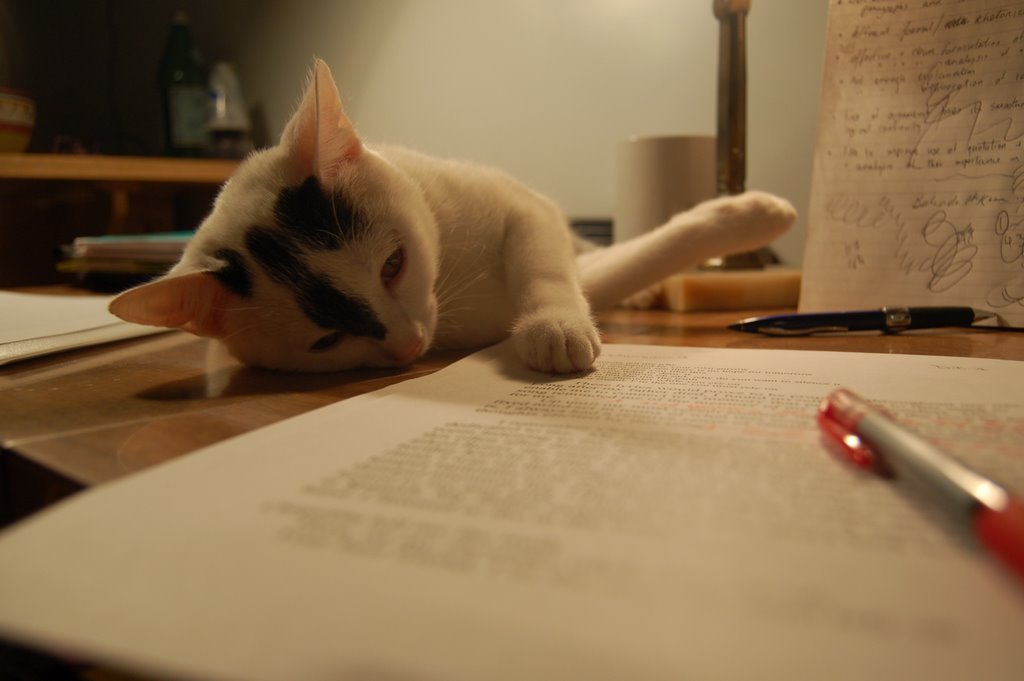
Thursday, November 02, 2006
Doherty gets Moss's ring stuck on his finger. No, I didn't make that up.
 The latest from the Kate Moss/Pete Doherty farce...
I still want to believe this guy is an elaborate KLF hoax. But even they couldn't dream up half the stories that come out about him.
In other news, how much more closely can Kate Moss come to resemble a wig-wearing Ian Beale before she is no longer considered a supermodel? Just wondering...
Wednesday, November 01, 2006
The Richard Ford Trilogy, NYT Style
 A Seattle reader of the New York Times has done what has needed to be done for a long time: he has socked it to the newspaper over its odd policy of often reviewing the same book twice, once on the weekday pages and once in the Sunday review. In this case, he's talking about what he saw as excessive coverage of Richard Ford's new novel, The Lay of the Land. The novel got two reviews, a reasonably poor one from Michiko Kakutani, and a more glowing specimen from the paper's film critic A.O. Scott. In between the two, the Arts section carried a front-page feature on Ford and the travels he undertook as part of his book research. At this stage, the reader wondered whether Ford had an "in" with the newspaper.
Publishing a feature as well as a review seems reasonable to me, especially in the case of a book as eagerly awaited as this one, which is the last in Ford's acclaimed Frank Bascombe trilogy. But the policy of double-reviewing has never made sense to me, particularly since the reviews are often in complete opposition to one another. Yes, there's a lot to be said for diversity of critical voices on a new title, but not in this form. Either publish one review and have another critic respond to that review, or publish one review full stop. Or, publish one review and allow the opportunity for another perspective on the book to come across in the course of a feature or interview. But publishing two reviews? Get off the fence. And use the weekday pages for other books. It's not like there aren't enough of them waiting to be reviewed.
Read the complaint, and the borderline-sniffy response from the NYT's public editor, here. (Registration may be required, but it's free.)
I'm off to my first class with Orhan Pamuk. Up for discussion is Mann's Tonio Kroger. Report later on...
Tuesday, October 31, 2006
Things Learned in a Poetry Class
note: the second half of this post is supposed to be hidden behind a clickable "read-on" link, but blogger's "span/fullpost" etc html doesn't seem to be working anymore. Does anybody know the story? Any alternatives? Just looking at this solution makes me want to go back to pen and paper. Until then, sorry for the length of this post.
• In 1971, while rushing to dinner with his wife, the French poet Jean Follain (well discussed here), died after being struck by a car on a Paris corner. It was the exact corner on which his father had been knocked down and killed years previously. 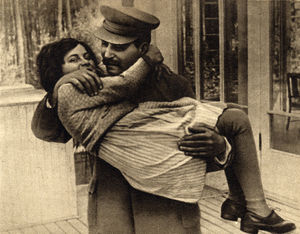 •
In 1970, Svetlana Alliluyeva Stalina (seen, right, aged nine with her devoted daddy Joseph Stalin), received an invitation from the widow of the architect Frank Lloyd Wright. Stalina had recently defected to the U.S., causing uproar in the USSR for her denouncement of her father's regime and the publication of her memoir Twenty Letters To a Friend. Wright's widow invited her to come and visit her at Taliesin West, Wright's winter home and school in the desert of Arizona. A mystic, she was convinced that Stalina was a spiritual replacement for the daughter she had lost in a car crash, a woman also called Svetlana, who had been married to Wright's chief apprentice, William Peters. Stalina visited Arizona and had agreed within weeks to marry Peters. Stalina now lives in a retirement home in Wisconsin.  • Robert Lowell taught an undergraduate workshop in poetry at Harvard in the early 1970s. In lieu of the usual workshop approach of reading and/or listening to the poems of participating students, Lowell preferred to read aloud from a battered anthology of poems he admired. Every so often he would turn to the students, with ten minutes left to go before class ended, and ask them to read a poem. They were mostly eighteen years old, and understandably reluctant to follow in the wake of Marvell, Browning and Yeats. One of the students took a shine to an attractive girl in the class. One day, after class had ended, he asked her out. She walked away without speaking to him. A classmate filled him in on his faux-pas: he had just propositioned the Lowell girlfriend of that class. There was one in every class. Also, there was Elizabeth Hardwick, the wife he was in the process of leaving, and Lady Caroline Blackwood, the wife he was in the process of acquiring. Lowell was eccentric, but generous. He invited the whole class out to a meal in Cambridge. They all went. Meanwhile, Lowell went to the airport and took a flight to London, where he lived for pretty much the rest of his life.
 • Something I remembered tonight about Lowell: when he died of a heart attack in 1977 in the back of a New York cab, he was returning from JFK airport, having flown there from Dublin. There, he had finally ended his marriage with Blackwood, who was an heir to the Guinness fortune and lived on the family estate at Castletown House, Co. Kildare. When Lowell died, he was on his way back to Hardwick, who lived in Manhattan. He died with a painting in his arms. It was a portrait, now famous, of Blackwood, by her previous husband Lucien Freud. I think I remember hearing somewhere that he had robbed it from Castletown's walls. But maybe I'm imagining that bit.
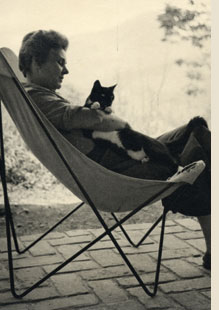 • Teaching in Harvard at the same time as Lowell was his great friend, the poet Elizabeth Bishop. His classes were taught in a penthouse with a stunning view of Cambridge; hers were taught in a damp basement. She was calmer than Lowell, which wouldn't have been difficult. She grew exasperated with her students, who were desperately self-conscious about their readers, their potential readers, their imagined readers, and about what all these people might say about what had been written or appropriated or revealed, when in fact their poems had, as of yet, no readers at all save for themselves and their teachers. She slammed a notebook down on the desk one day and said to her students, look. When you begin work on a poem, the thoughts that go into that and the material that goes into that process forms a bridge between you and hte page. And when your reader reads the finished poem, the poem forms a second bridge between the page and them. And your readers will never see the first bridge. Only the second one. So stop thinking about what your readers will think of your material. They will never be on that bridge.
• In French graveyards - at least in some French graveyards - there is a symbol for the grave of a suicide.
• In 1910, Houdini was the first man to fly an airplane successfully in Australia. As well as flying, he performed. During one performance in Melbourne, he jumped, bound in chains, from a high bridge into a river. Moments later, he resurfaced, free of his chains, and saw in the water beside him something that nearly caused him to drown. 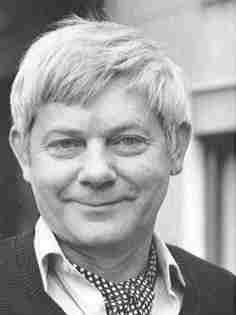 • The Polish poet Zbigniew Herbert (right), who would have been 82 this week had he lived, was a descendant of George Herbert, somehow.
• On the last three points, learn more below. You'll have to read some poems. They are worth reading. I suppose I shouldn't really be printing them in full. But I am.
Outside Perpignan in Heavy Rain from In the Year of the Comet (1992) by Nicholas Christopher
The trees sway darkly
along the black wall with its vines.
For shelter, a cat squeezes between the steel bars over a window.
This is where the caretaker lives,
catty-corner to the cemetery,
with a door the color of stone.
We've just descended the mountains,
windshield wipers slapping mud
while we talked about the acrobat
who was in the papers in Barcelona
yesterday; how he attempted
to perch blindfolded on the highest
steeple of the Gaudí cathedral.
Through the gate, in the first
row of gravestones, a statue
depicts a young woman
raising her hand to her face:
the mortuary sign for a suicide.
Is she about to touch her forehead?
to tear out her hair?
to dig her nails into her cheek?
to stifle a cry
or make the sign of the cross?
In this life which is the only life
it is a gesture we see every day.
You say someone in a position
to know told you it's easy
to learn about these things
without ever learning anything at all.
Without ever running out of questions.
When that acrobat fell in bright sunlight,
did all the women in the street raise
their hands to shield their eyes?
From 5º (5º and Other Poems, 1995) by Nicholas Christopher
In 1910 Houdini was the first man to fly
an airplane successfully in Australia.
It was a biplane, purchased in France,
which he took to Melbourne on a ship.
During the two-week voyage,
he was continually seasick,
yet spent hours in the cargo hold,
poised at the controls of his plane.
He had HOUDINI painted on the fuselage
and wings in red and gold.
In Melbourne he gave two performances nightly.
He made a full-grown elephant disappear.
He caused a man's top hat to fill with coins.
He had himself submerged, straitjacketed
and handcuffed, in a tank of ice water.
Then he left his wife at their hotel and hurried
to a desert airstrip to sit in his plane.
He kept this up for weeks, studying charts,
waiting for the weather to clear.
On the evening of February 18th, a crowd
watched him leap manacled from Queen's Bridge
into the muddy waters of the Yarra River.
Moments later, a dead man floated to the surface.
The onlookers panicked, and when Houdini
reappeared, he was so startled to see
the corpse that he nearly drowned
and had to be hauled
into a rowboat by his attendants.
Finally, on March 16th, under cloudless skies,
he took off in his plane, circled, and landed.
He completed three flights that day,
covering seven miles at an altitude of ninety feet.
At each stop, bigger crowds cheered him on.
In April, he made four more flights
before crashing outside Sydney on the 22nd.
He walked away from the wreckage unscathed
and told his wife he had not slept in a month.
"I now seem to have lost the habit," he added.
To his journal he confided that history
would remember him, not as a magician,
but an aviation pioneer.
During the voyage home, he was seasick.
He never flew again.
Remembering My Father from Mr. Cogito (1974) by Zbigniew Herbert
Trans. J & B Carpenter
His face severe in clouds above the waters of childhood
so rarely did he hold my warm head in his hands
given to belief not forgiving faults
because he cleared out woods and straightened paths
he carried the lantern high when we entered the night.
I thought I would sit at his right hand
and we would separate light from darkness
and judge those of us who live
- it happened otherwise
a junk-dealer carried his throne on a hand-cart
and the deed of ownership the map of our kingdom
he was born for a second time slight very fragile
with transparent skin hardly perceptible cartilage
he diminished his body so I might receive it
in an unimportant place there is shadow under a stone
he himself grows in me we eat our defeats
we burst out laughing
when they say how little is needed
to be reconciled