After the Irish reading, we legged it up to the KGB for another reading, because I'd read a lot about Joshua Ferris's new novel, And Then We Came To The End (check out the fancy website here), and I wanted to hear him read from it. Ferris was an engaging guest blogger on The Elegant Variation last week, which I chatted to him about when he found himself inescapably stuck beside me in the tiny, overcrowded venue. He seems like a nice guy - talked about how time-consuming blogging was, and how he only ever did it at night, and how he couldn't imagine trying to do it all the time, while working on his fiction too - and he hung my coat up, so I'll definitely be buying his book. Oh, and it also sounded very good (if a little cinematic) - it's about office dwellers, and narrated in that horrible, cloying "we" voice, the first-person plural, beloved of HR departments everywhere - a nice touch, which knifes straight into the deadening, depersonalising heart of corporate culture. Anyway, they weren't selling the book in the KGB, so I'll have to hunt down a copy, and I'll report back when I have read it. I'm sure it will be a lot better than the novel I read last week, Andre Aciman's Call Me By Your Name; I don't know how Colm Toibin and Nicole Krauss could blurb it with straight faces. He wrote it in four months -clearly after having gorged on To The Lighthouse - and it shows. I like his non-fiction a lot, but this...no.
Getting back to the KGB reading - which will eventually be available to hear, along with interviews, here - Ferris was preceded by two other very enjoyable writers, Liam Callanan, whose new novel All Saints I'm reading at the moment (it was on sale on the night) and really enjoying, and Elise Blackwell, who read from her novel The Unnatural History of Cypress Parish, which is about the floods which struck Louisiana in 1927. The book was all but finished when Katrina hit last year, and Blackwell felt it had to be completely rewritten, and relocated, in the light of what had happened. So her narrator now tells the story of one flood on the eve of another.
Monday, March 12, 2007
And Then We Came To The KGB

Tuesday, February 20, 2007
Neighbourhood Snark
 Speaking of blogging and the L train...
Over the weekend, while writerprocrastinating, I discovered nycbloggers.com, a New York City blogging map, which lists blogs by subway line and subway stop. Think of it as a sort of Gawker Stalker for bloggers. My subway stop, the Grand Street L stop, has 18 blogs listed. I haven't yet joined up because of their "New Yorkers Only" criteria, which made me stop and think about whether I could qualify as a New Yorker...and the next line on their form is "if you have to ask whether you qualify as a New Yorker, you're probably not." Huh. They also say ex-pats are welcome, but I don't think they mean Irish ex-pats, exactly...
Anyway. Forget all of that. My initial pleasure at finding a blogging map to poke around at was quickly curtailed and transformed into sheer terror. What kind of sheer terror, you ask? Well, the kind of sheer terror that only a writerprocrastinator - that is, only a trying-to-write-a-novelist - acquainted with the catty directness of Miss Snark, Literary Agent can understand. Miss Snark tells it like it is. She's an agent, who writes an anonymous blog in which she answsers questions from idiot (and not so idiot) writers about querying, agent-hunting, agent-pestering and publishing, and she doesn't mince her words. Witness her crapometers for synopses, query letters and first pages. Yeah, those sarky red notations she inserts into submissions as she tears them to shreds are funny. Catty. Hilarious. Until you find it's time to write a synopsis or a query letter yourself (NOT for Miss Snark...who would seriously put themselves through that ordeal?), and then you start to see her red notations in your dreams. She scares the bejaysus out of me.
So, you'll be wondering about the reason for my nycblogger.com-induced sheer terror. Turns out Miss Snark lives one subway stop away, at Montrose Avenue. That's less than ten blocks away. I probably see her on the subway every morning. Oh my god, what if she has seen me reading over print-outs of my bloody novel? Standing behind me during the morning rush and snarking silently over my shoulder? Aiming virtual red-pen squiggles at my every page?
Thanks a bunch, nycbloggers. Making me feel like a tourist in NY was bad enough. But this is just too much.
Tuesday, February 13, 2007
Yup, And The Editor In Chief Is Cathleen Ní Houlihan...
He runs one of the best literary blogs out there, and he's barely one to be fooled, but Mark Sarvas over at The Elegant Variation fell hook, line and sinker today for Newton Emerson's satirical take on Gerry Adams, Writer Extraordinaire, which was published in the Irish Times a (full) month ago (and covered by Blogorrah here).
In a post entitled "Why Didn't We Think Of That?", TEV faithfully quotes from Emerson's piece on Adams's refusal to publish the third volume of his memoirs without the guarantee of good reviews. The gag about how Adams is believed to have "serious reservations about the final chapter" is also taken as fact, as is the quote from "Ulysses Grant", Emerson's fictional Irish Times literary edtor:
Like most creative people, Gerry Adams is surprisingly sensitive...[h]e finds it difficult to finish anything unless he's absolutely sure that everyone will love it.
And TEV rounds it all off with a hilarious crack about a car bomb, before the commenters come in to rain on his parade.
Wednesday, November 01, 2006
The Richard Ford Trilogy, NYT Style
 A Seattle reader of the New York Times has done what has needed to be done for a long time: he has socked it to the newspaper over its odd policy of often reviewing the same book twice, once on the weekday pages and once in the Sunday review. In this case, he's talking about what he saw as excessive coverage of Richard Ford's new novel, The Lay of the Land. The novel got two reviews, a reasonably poor one from Michiko Kakutani, and a more glowing specimen from the paper's film critic A.O. Scott. In between the two, the Arts section carried a front-page feature on Ford and the travels he undertook as part of his book research. At this stage, the reader wondered whether Ford had an "in" with the newspaper.
Publishing a feature as well as a review seems reasonable to me, especially in the case of a book as eagerly awaited as this one, which is the last in Ford's acclaimed Frank Bascombe trilogy. But the policy of double-reviewing has never made sense to me, particularly since the reviews are often in complete opposition to one another. Yes, there's a lot to be said for diversity of critical voices on a new title, but not in this form. Either publish one review and have another critic respond to that review, or publish one review full stop. Or, publish one review and allow the opportunity for another perspective on the book to come across in the course of a feature or interview. But publishing two reviews? Get off the fence. And use the weekday pages for other books. It's not like there aren't enough of them waiting to be reviewed.
Read the complaint, and the borderline-sniffy response from the NYT's public editor, here. (Registration may be required, but it's free.)
I'm off to my first class with Orhan Pamuk. Up for discussion is Mann's Tonio Kroger. Report later on...
Thursday, October 26, 2006
Master of Tact Returns to the Airwaves
Goodbye, Con Murphy. It was fun while it lasted. You didn’t make racist,homophobic, sexist or just plain stupid remarks, we didn’t have to listen to your unprofessional blundering around issues of age or sex or technology nor anything else (note to Tubridy: when you want to know somebody’s age, just ask them. Stop this whole faux-polite “um, um, may I know what general age group you are in, if you don’t mind…um, haahaa, just, well you know what I mean,” etc) and you had clearly actually read the books (for once, something that was not a what-ho British book about boys’ hobbies! Joy!) and watched the films and whatnot up for discussion. (Though you could have talked a bit more about Dallas during that John Doyle interview; that would have made me really happy.) Now Turgidy is back; curse those advances in tonsilitis medicine. He’s interviewing Kevin Myers at the moment, and has already made him sound like a charming, subtle, intelligent speaker by comparison.("predilection for women", aargh, "I was an ardent young man", aaaaarrrrgh, "the female thing", stop it, oh my god Turgidy just spat out the word "threesome", now he’s talking about a woman “doing what she does on her own”, which is his euphemism for masturbation; I want to die). At least Jane Ruffino is coming on soon, and she is going to kick his tweed-jocked arse.
I mentioned Dallas, didn’t I? So that’s justification enough for this…
Friday, October 13, 2006
Genius
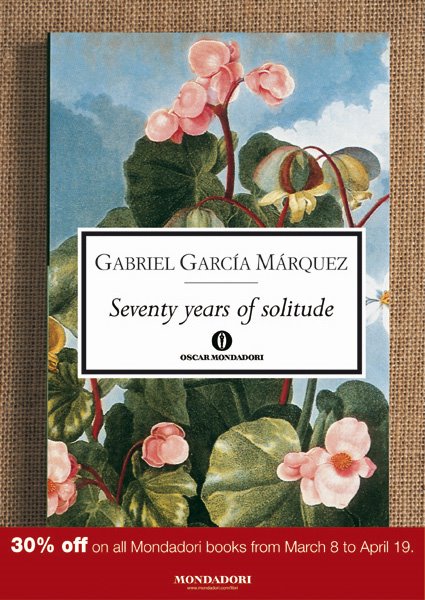

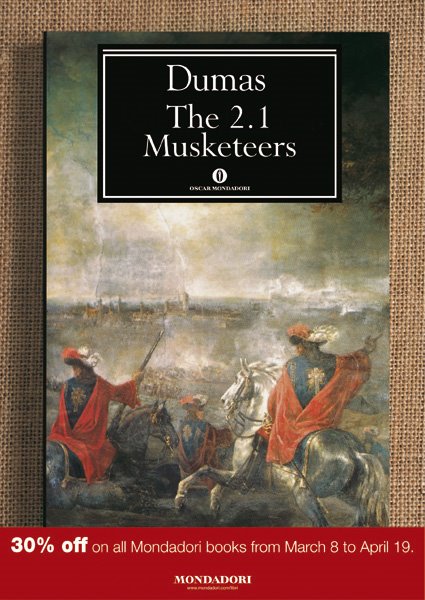
I'm stealing this straight from Gawker, but it's too good not to steal. These images are from a campaign devised by Saatchi & Saatchi for the 30% off sale at the Italian English-language bookstore Mondadori earlier this year. Thinking about how this campaign might have advertised Irish novels, there aren't many contenders. Flann O'Brien seems to lead the way where numerical titles are concerned. I wonder how At Swim 1.4 Birds and The 2.3rd Policeman sold during the Mondadori sale. Better than The Barrytown Dilogy, I'd imagine. Or Paddy Clarke Ha Ha h...
Never mind.
Tuesday, October 03, 2006
What James Wood Does Like to Read
I took a seminar with James Wood this semester. It's over now, even though the semester has barely started, which makes me feel gloomy, because he was a brilliant teacher; passionate and insightful as a reader of Bellow (the stories), Dostoevsky (Notes from Underground), Chekhov (stories) and Woolf (To the Lighthouse) and adept at talking about these works not just from the perspective of criticism, but of craft. He also had a very entertaining story about his own doppelganger, and about the Dostoevskian saga which ensued for him following the intervention into his life of that person, who shared his name and his occupation, and, for a while, showed up at every turn for Wood, writing letters, reviews, and even blurbs. It reminded me strongly of Paul Auster's novella City of Glass, but probably because that, in itself, is one big Dostoevskian trope.
Anyway, after the last class, Wood took some time to talk about "literature in general" and to take any questions the class had on this subject, and of course somebody asked the question that was on everybody's lips ("Which books have you liked in recent years?"), albeit phrased more delicately than others might have put it, given Wood's no-nonsense tack as a critic ("Is there anything you've ever liked?") And, while Wood was happier to give names (Spark, Sebald, Bellow, Coetzee, and the earlier Roth) than titles, there were a few that he singled out: 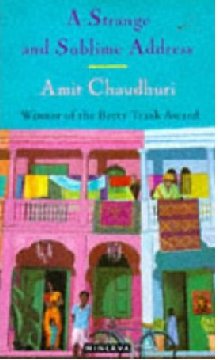 Amit Chaudhuri's collection A Strange and Sublime Address(1991)
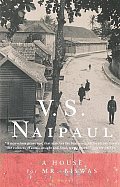 V.S. Naipaul's novel A House for Mr. Biswas (1961)
 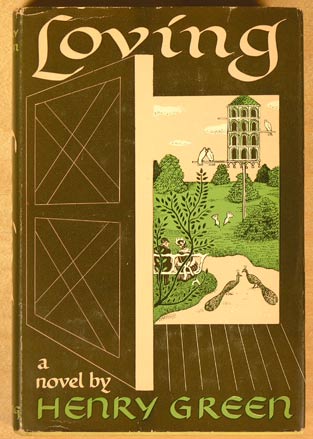 Henry Green's novel Loving (1945)(see Wood’s TLS article on Green, from the TLS last January).
Naturally, I haven't read any of them; this is the first I've heard of Green, in fact. His novel sounds intriguing, set as it is among a bunch of servants in a castle in Ireland during WWII. I didn't get to ask Wood what he thought of Bowen, or of any other Irish writers; his slow, somewhat agonised but still fascinating revelation of his favourites was then intercepted by a bland question about marketing and the young writer (snore), so there were revealed no more than these. But at least it saved me from yet again displaying my provincial tendencies for all to see.
Friday, August 18, 2006
Frank Bascombe, Older and Hardly Wiser...

The new Richard Ford novel, in proof form, just arrived on my desk (wait, I don't have a desk. I mean, my kitchen table.) I haven't read it yet, obviously (at 485 pages, it will probably keep me going for a while) but I'm looking forward to seeing whether Ford has managed to convincingly get back into the voice of the narrator he first created 20 years ago, with The Sportswriter and returned to for Independence Day. Like each of those novels, it's set on a holiday, this time Thanksgiving, in the year 2000. So it's America before 2001, and before Bush (the Florida votes farce is still ongoing), and that in itself will make for an interesting read.
Something else I'm looking forward to reading today is the rehearsal script of Stuart Carolan's new play, The Empress of India, which opens in Galway and moves to the Dublin Theatre Festival. Carolan's first play, Defender of the Faith, was perhaps the strongest new work (in terms of "straight" plays) to open on an Irish stage in 2004, and perhaps even since then. When I was in the Abbey over the summer I noticed that the script was still for sale in the lobby there for something like €8. That's a recommendation, in case I'm being too subtle...The cast for the Galway/Dublin production looks terrific, including Sean McGinley in his first stage outing in five years, Aaron Monaghan, Catherine Walsh and Tadhg Murphy. It doesn't open until Sept 12, but I'd be interested to hear the views of anybody who gets to see it.
What else...slipped into my bad habit of listening online to RTE Radio 1 again while working (too depressing listening to NPR these days, most of the time...Israel or nothing) but today wasn't too bad; caught the excellent Rattlebag special on trad, and am now listening to the RnaG live stream ( I was going to write there, "I'm not a smug gaelgóir, I just listen for the music" but if I was a gaelgóir of any sort, rather than a head-hanging-shambles of an Irish speaker, it would be the smug sort, so forget about that). My neighbours probably hate me. But then, I hate them too, with their constantly appearing newborns and enormous dogs. That sounds very uncharitable. I like dogs and babies. But in a building which, even if it were a house, would arguably not be big enough to hold one of each, the apparent presence of several of them tends to grate on the nerves. Which reminds me. We're getting a kitten (now that it's in my blog, A, it has to happen. Ok?). Names suggested so far: Spling, Doodlemunch (long story) and Wee Thomas (short story...ok, downright theft). The eventual name, however, will depend on the unique personality and litterbox-related delinquency of the kitten itself.Dandelion, maybe?
Oh yeah. And the view is completely gone now. I don't want to talk about it...
Thursday, June 22, 2006
Doyle and Enright give The Irish Times what for
 It's a pity that Eileen Battersby, Literary Correspondent of The Irish Times didn't elaborate on the barbed comments directed at that newspaper, and at Irish literary critics - that is, directly at her, among others - by Roddy Doyle and Anne Enright during their public interview as part of last week's Dublin Writers' Festival. Perhaps it was just mentioned in passing, but this is all her report had to say on the matter:
Both he and Enright shake their heads over what they see as the ongoing stupidity of The Irish Times, all that is wrong with society is invariably reflected in its cosy pages. They also agree that there are currently 40 good Irish writers and no good literary critics, "the film critics are even worse."
 Firstly, 40 good living Irish writers is too generous an estimate. It really is. It sounds like a figure pulled out of the air, possibly as a joke. I can think of maybe 15 good Irish writers. Maybe, just maybe, 20. In fact, I'm going to try and write a list, and see how many I can come up with. I'll update later.
 Secondly, on the cosiness of the Irish Times: Fair play to Battersby for mentioning the comments, I suppose, even if she doesn't do much more than tack it onto the end of her article. I have to wonder whether Doyle and Enright gave a fuller idea of what they meant by cosiness when they used that word (if they used that word - it's not in quotes). Were they talking about the newspaper as a whole, about the arts coverage, about the books pages, about the opinion pages, about the Saturday magazine, to which Enright herself is a reasonably regular contributor? (It looked like she might have been taking over Roisin Ingle's column for a while there.) It's difficult to respond to their criticism without knowing.
Thirdly, and related to this last point: the dearth of good Irish literary critics. I have mixed feelings on this. Ireland does not exactly boast a vibrant and strengthening critical climate where literature and the arts are concerned, but I don't for a minute agree that there are no good Irish literary critics. Again, it would be good to know what they mean by critics - if they're talking just about critics of fiction, or if they mean critics of every form of writing, from poetry to history and biography. It's unclear, too, whether they refer to academic critics, novelists who review novels, journalists who review anything they're handed, or a mixture of all three. Even if it is a mixture, I can think offhand of examples from all three fields who I count as fine critics. Again, I'll try to update with a fuller list, but here are some critics, or reviewers if you want, who publish in Irish newspapers and journals, and whose writing I respect: Nicholas Grene (academic). Colm Toibin (novelist). John Banville (novelist and former literary editor of the IT). Declan Kiberd (academic). Dennis O'Driscoll, Peter Sirr and Vona Groarke (poets). Susan McKay (political journalist and book reviewer). William Wall (novelist, who wrote brilliantly on Irish poetry in the magazine the Shop a few months ago). There must be others, and I know I'm sticking too closely to the reviewers of the Irish Times, but really where else do you look for a serious and dedicated book review section? There's also the Irish Book Review, which has some good reviewers, but it seemed, in its early issues at least, overly cliquey and unlikely to display any real diversity or unpredictability in its views on Irish books. Also, the reviews in those early issues were just plain poor; often badly written, and either petty or parochial.
On film critics: Donald Clarke is very good. Apart from him - and I doubt Enright and Doyle were even thinking of the internet as a valid source of reviews or criticism - I look mainly to blogs for reviews of film and for other criticism. But it's true, there's nobody in Irish film criticism of the calibre of, say, Anthony Lane. That said, what real outlets would there be for someone writing longer, more considered reviews like his? (I haven't read Film Ireland for a while. Maybe it has reviews like that? I don't know.)
I notice they didn't touch on theatre criticism, nor would I expect them to in this context. That's a whole other day's work.
I'd say that Doyle and Enright made for a formidable team once they got going together on this. They're both outspoken, eloquent, sharply intelligent and utterly intolerant of bullshit. If they were given an hour to talk about newspapers and literary criticism in Ireland, I'd be on the next plane home to hear them. I'd also hope for a slightly fuller account of the debate in the paper the next day (or six days later, whatever you can manage), but that's just me. And, like I say, the comments were possibly just part of a really rapid-fire discussion, and were not dwelt upon long enough to merit a fuller mention.
Some other features of the interview (Enright interviewed Doyle), from Battersby's article today:
• Doyle didn't suffer fools from the audience gladly. He doesn't suffer windbags gladly either. Or maybe he just didn't suffer audience members, full stop. A woman wanted him to know she didn't enjoy The Commitments; he seems not to have bothered even to reply. A man wanted to know about his views on "religion and churches". "I'm an atheist," Doyle responded bluntly. That was the end of that.
• Doyle admitted that the actor Ger Ryan's interpretation of his character, Paula Spencer, in the stage version of his novel The Woman Who Walked Into Doors had made for a "different, stronger" version of the character and that, as he wrote the sequel to the novel (which will be published in September), he was aware of the challenge this posed to his own characterisation of her. At least, I think that's what he's saying. Maybe he's talking about the stage version, which he helped to adapt. Again, it's a little unclear. But if this is the challenge he's talking about, it's a very interesting one, and I guess one that other authors have faced too, as they write sequels, or the next book in a series.
• He talked about the number of "wrecked, baldy old guys" who come up to him in the street and tell him that he used to teach them. Others, or maybe the same guys, are "recovering heroin addicts...the ghosts of young kids he used to teach," writes Battersby.
• Enright came across, writes Battersby, "as a harassed housewife on temporary day release from her children," and complains that she has no time to read. But she's shrewd and alert as an interviewer, and knew "how to turn an interview into an apparently casual conversation. She [was] also asking Doyle the right questions." Another reason why she should write for the Irish Times, then. Sign her up!
• Doyle would love to live in New York. You can stay with us, Roddy. Just for a couple of days, mind.
• The recent changes to Ireland's population, which have seen large numbers of immigrants come to the country over the last five to seven years, have created an unexpected bonus for Doyle, who's a pretty recognisable figure in Ireland, as writers go: "I can walk down the street without every tenth person asking me if I'm Roddy Doyle." He also mentions in passing that he's learning Polish. Is he? Was this said ironically (he also said he's the only person on his bus route now who speaks English) or in dead seriousness?
• As was already known (it was discussed at some length in Angela Bourke's biography, and in Doyle's book Rory and Ita), Doyle's second cousin was Maeve Brennan, the famous Irish New Yorker writer, who wrote the magazine's Talk of the Town column during the 1950s and 60s under the pseudonym of the ”Long-Winded Lady”. Doyle spoke a little about her on Friday; he was 14 when she came to stay in his family home for a few months. That would have been around 1972, when things had begun to fall apart for Brennan. She rarely ate, stayed in her room with the curtains closed, and wrote furiously. Doyle, on Friday, remembered her as "incredibly elegant and eccentric", bewildered by an Ireland she no longer knew. He didn't speak to her about writing, because he wasn't interested in it at the time.
• Enright talked about something interesting: the emergence of an underclass in Dublin, or in Ireland (not clear which), and how this is something different to the working-class. Again, more on this would have been fascinating, but perhaps space didn't allow it...or something... anybody who was there, please comment!
• Doyle on the linguistic gift of the working class (in Dublin, I think): "A well-aimed working-class insult can do in two sentences what it would take a barrister three days to do."
• After they made their '40 good writers' remark, the audience got involved, shouting out the names of other Irish writers to see what Doyle and Enright had to say about them. Battersby remarks that "the expected [were] praised". It'd be good to know who the praised and the unpraised were, but only one is named in the piece: Jennifer Johnston, whose work Doyle said he loved. It's the duty of the writer, he said, "to produce good work."
Yeah, and it's the duty of the literary journalist too.
That's Stephen James Joyce to you...
 What do we think of Stephen Joyce around these parts? Sorry, Stephen James Joyce, to give him the full name upon which he insists. Well, we think that it would be fascinating to see SJJ’s response if all the scholars and critics stopped showing an interest in Joyce’s writings, and in his life, all of a sudden; if the Joycean industry drew to an unceremonious halt. And people stopped reading, and stopped analysing, and stopped thinking about SJJ’s grandfather. Because that’s what you want, isn’t it, SJJ? That’s what you mean when you tell D.T. Max, in this week’s New Yorker, (ETA: now last week's...this has been on the backburner for a while, sorry) that academics are like “rats and lice” and “should be exterminated”, isn’t it? That academics are “people who want to brand this great work [Ulysses] with their mark”, and that you “don’t accept that”?
But you like your own mark on Ulysses, and on the rest of the Joyce estate, to be clearly visible. In fact, along with the Great Wall of China, it can probably be seen from space. That’s unusual for a big, grubby set of fingerprints, but you’ve proven that nothing’s impossible. You say that if you had “the energy”, you’d write a book about your grandfather, and about how he was treated by Ireland. You don’t mention whether or not you think yourself to have the talent to do that, though. To write a book. Funny that you never have. Don’t you feel capable? Do you wish you were as famous as your grandfather? Could that be what all of this fuss is about?
Below, some highlights from Max’s excellent New Yorker piece, which I think give an insight into the mind of the man.
In 1988, he took offence at the epilogue to Brenda Maddox’s Nora, a biography of Nora’s wife, which described the decades that Joyce’s schizophrenic daughter, Lucia, spent in a mental asylum. Although the book had already been printed in galleys, Maddox, fearing a legal battle, offered to delete the section: the agreement she signed with Stephen also enjoined her descendants from publishing the material. Shortly afterward, at a Bloomsday symposium in Venice, Stephen announced that he had destroyed all the letters that his aunt Lucia had written to him and his wife. He added that he had done the same with postcards and a telegram sent to Lucia by Samuel Beckett, with whom she had pursued a relationship in the late nineteen-twenties.
SJJ wrote at the time that he had not destroyed any papers or letters in his grandfather’s own hand – “yet”. But in the 1990s, he persuaded the National Library of Ireland to give him some Joyce family correspondence that was scheduled to be unsealed. Scholars worry that these documents, too, have been destroyed.
In 2004, the centenary of Bloomsday, Stephen threatened the Irish government with a lawsuit if it staged any Bloomsday readings; the readings were cancelled. He warned the National Library of Ireland that a planned display of his grandfather’s manuscripts violated his copyright. (The Irish Senate passed an emergency amendment to thwart him.) His antagonism led the Abbey Theatre to cancel a production of Joyce’s play “Exiles”, and he told Adam Harvey, a performance artist who had simply memorised a portion of “Finnegans Wake” in expectation of reciting it onstage, that he had likely “already infringed” on the estate’s copyright. Harvey later discovered that, under British law, Joyce did not have the right to stop his performance.
Ok, let’s pause here to think about that last one. By memorising a part of of Joyce’s work, an artist had violated copyright? D.T. Max’s article maintained a tone of appropriate distance from its subject, and somehow did not at any point erupt into exclamations of disbelief and disgust, but I don’t know for the life of me how he managed to resist the temptation. Probably David Remnick himself had to stand him a couple of strong brandies. You have to admire Max for writing this article without once using the words “insane”, “control-freak” or “roaring maniac”. Not about anybody in particular, that is. Just saying.
Let’s go on.
Stephen has also attempted to impede the publication of dozens of scholarly works on James Joyce. He rejects nearly every request to quote from unpublished letters. Last year, he told a prominent Joyce scholar that he was no longer granting permissions to quote from any of Joyce’s writings. (The scholar, fearing retribution, declined to be named in this article). Stephen’s primary motive has been to put a halt to work that, in his view, either violates his family’s privacy or exceeds the bounds of reputable scholarship.
Quoting from unpublished letters is one thing; though I’m firmly of the belief that the contents of unpublished letters can further the understanding of what drove and shaped an author’s work, and matter deeply for the development of serious scholarship around that work, it’s fair enough that an author’s estate gets to lay down conditions about the use of that content. They are personal documents, after all. Most estates are a lot more reasonable than SJJ, but I accept that, where the letters are concerned, his is the final word. However, the matter of quoting from Joyce’s published work is an entirely different one. The idea that he would prevent scholars, critics and artists from quoting from Dubliners or Ulysses on the grounds that such use somehow “violates his family’s privacy” begs further explanation. As does the notion that SJJ would somehow know, even before reading requests from scholars for the use of such quotes, that any use whatsoever would “exceed the bounds of reputable scholarship”. More from the whirring Eureka-vortex of SJJ’s brain, please! Here’s a suggestion for the next step: stop bookstores stocking the books, or, at the very least, stop them from displaying the books on their shelves in a way that the titles are clearly visible. Because that’s sort of a violation of copyright, too. And, come to think of it, so is the act of reading Joyce. Especially if you’re one of those people whose lips move as they read. Or, if you sometimes, for some reason, read aloud. For example, if you were reading to your precocious offspring from the pages of Joyce’s children’s book, The Cat and the Devil, based on a letter-story that your grandfather sent to you when you were a boy. Yes, don’t worry, SJJ, everybody knows that The Cat and the Devil, like all of Joyce’s writings, is really, secretly, essentially, at base, all about you! Don’t worry. You’re at the centre of everything to do with Joyce. As Max, in perhaps the article’s most pointed paragraph, points out:
The two-decade-long effort has also been an exercise in power – an attempt to establish his own centrality in regard to anything involving his grandfather…as he put it to me during two phone calls that he recently made to me from La Flotte, “What other literary estate stands up the way I do? It’s a whole way of looking at things and looking at life.”
And just a couple more samples of SJJ’s inimitable style:
When turning down a request for permission from an academic whose work was going to be published by Purdue, he said that he objected to the name for the university’s sports teams: the Boilermakers. (He considered it vulgar.) Michael Groden, a scholar at the University of Western Ontario, spent seven years creating a multimedia version of Ulysses, only to have Stephen block the project, in 2003, with a demand for a permissions fee of one and a half million dollars. (Before Stephen controlled the Joyce estate, such fees were nominal.) Groden’s sin was to have praised Danis Rose’s edition of Ulysses as “confident and controversial,” in a reader’s report for Rose’s publisher; he had also helped the National Library of Ireland to evaluate some Joyce drafts prior to acquiring them.“You should consider a new career as a garbage collector in New York City, because you’ll never quote a Joyce text again,” Stephen told Groden.
This week, Laurence Lessig, a law professor at Stanford, will file a suit against SJJ in United States District Court. He’s acting on behalf of the author Carol Loeb Shloss, whose book on Joyce’s daughter Lucia was published in 2003. The book was about Lucia’s mental illness, and before it was published, SJJ made clear to her publisher that he would sue if she quoted from copyrighted material. The book was published with cuts. While Shloss was fighting with SJJ, she met Lessig, a copyright specialist, who agreed to take on her case pro bono. He wants to show, to quote Max, that “distended copyright laws [are] not in the public interest.” His case this week will be the first to accuse a literary estate of “copyright misuse”.
Shloss’s book, it should be said, is by no means an example of why scholars should be allowed greater leeway when it comes to quoting from copyrighted Joyce material. There’s something decidedly sensationalist about her project; to probe into the mental illness of Joyce’s daughter is hardly an exercise in Joycean scholarship. So in a way her case is not ideal as a challenge to SJJ’s grip on the estate. But then, Lessig’s not challenging the grip itself so much as he is challenging the way SJJ wields that grip. During Shloss’s attempt to publish her book, she and her publisher received letters and phone calls of a threatening manner from SJJ. She alleges he was practically spying on her at one stage, and that he made concerted attempts to block her research - by removing documents from libraries, for example. It’s against that kind of behaviour on the part of an estate that Lessig is taking a lawsuit. Intellectual property specialists think he’s unlikely to succeed; the precedent such a success would set for estates would be too drastic. But it’ll certainly be an interesting one to watch.
Wednesday, June 21, 2006
Alice Munro to retire?
 Via the Elegant Variation comes very sad news: Alice Munro is expected to announce tonight, at a fundraiser in Toronto, that she has written her last book.
Munro is scheduled to give a reading at a benefit and book launch for Writing Life, a PEN Canada anthology of essays from 50 Canadian and international authors that is scheduled to hit stores July 1. In her contribution to the volume, Munro cites a tremor in her writing nerves in the face of constant interruptions and advancing age. (She will be 75 next month.) She says she can quit writing "in the interests of a manageable life" and with the knowledge that it's rare for outstanding work to be produced in a author's later years, "so one or two books fewer won't really be anybody's loss."
Many will beg to differ.
She is a master of the short story, and her work, in its sober, exact beauty, recalls that of another writer whose pen fell silent too soon, John McGahern. Her next book will be her 13th, another book of short fiction, which is due for a November release. Here's what the MacDowell Colony had to say this year as it awarded her its highest honour, the MacDowell medal:
"Reviewers have often compared Munro to Chekhov, and this is no overstatement. When you close a book of hers, you know a lot more about what it means to be human."
If the rumours are true, her voice will be much missed.
Tuesday, June 20, 2006
Snippets
Barbara Epstein, co-editor of the New York Review of Books, has died. [LA Times]
Robert Birnbaum interviews Susan Orlean, author of The Orchid Thief and staff writer at the New Yorker. She talks about the increasing challenge of pitching more offbeat, non-celebrity-centred ideas to magazine editors...though I'm guessing she has it a lot easier than most writers. Then again, if she finds it tough, what hope for the rest of us? [Identity Theory]
Speaking of the New Yorker, there's a blog all about/obsessed with it, which has somehow recruited two anonymous staffers from the New Yorker to answer readers' questions (pre-vetted by the blog, of course) about the magazine. Unsurprisingly, Gawker and some of its readers already have a couple of suggestions:
-Are rejected submissions used as toilet paper?
- How do fact-checkers not kill themselves?
-Are all of your cartoonists bitter divorcees?
-Is it a prerequisite of publication that a short story be mind-numbingly boring and/or have characters who I don't really care about whose names I can't pronounce?
-Must all short fiction submissions end abruptly, sans denouement?
The Middle Eastern edition of Elle will hit newsstands in Lebanon, Jordan and Morocco this Friday. A second, more conservative version of the Lebanese publication will hit Saudi Arabia in October. Along with shoots heavy on accessories and beauty products rather than on clothes, the first issue will feature an article on The Vagina Monologues- which uses synonyms for 'vagina', rather than the word itself, throughout. Challenging. Will Orlean be pitching? [Wall Street Journal]
Wednesday, June 14, 2006
Dick and Jane go to the IMPAC awards
 Is it just me, or is there something bizarrely childlike about this NY Times headline about Tóibín's IMPAC win?
What next? Karl Rove is a Good Boy?
Tuesday, June 13, 2006
IMPAC: The Right Winner
 Well done Colm!!
Irish author Colm Tóibín has won the International IMPAC Dublin Literary Award for his novel The Master, a portrayal of American writer Henry James.
Mr Tóibín, whose previous novels include The South and The Blackwater Lightship, is the first Irish writer to win the world's richest literary prize-worth €100,000 - for a single work of fiction published in English.The Master was chosen by an international panel of judges, fending off competition from nine other writers.
The judging panel described The Master as "a powerful account of the hazards of putting the life of the mind before affairs of the heart." "This probing portrayal of Henry James is not merely an outstanding narrative. In crisp, modulated writing, it subtly balances a range of devices that leave the reader in no doubt about the accomplishment of this work.
"The Master is and will continue to be a work of novelistic art: its preoccupations are truth and the elusiveness of intimacy, and from such preoccupations emerge this patient, beautiful exposure of loss, and the price of the pursuit of perfection.
But it's a very good thing you didn't call your novel The Boss. Talk about having your thunder stolen...
Update: Tóibín has just been on the News at One to give his views on Haughey: unlike most of the assembled journalists, editors, etc, he didn't mince his words, mentioning Charlie's pomposity. But he also pointed out that he has a lot to thank Haughey for today. Because were it not for Haughey and the tax exemptions he introduced for artists in 1969, Tóibín would have to pay enormous tax on the €100,000 prize he has just netted. And €100,000 is still well under the €250,000 cap that was introduced on the exemptions scheme in last year's budget.