Following Tuesday's post about Ryan Tubridy's thunderingly ignorant approach to theatre criticism (in summary: don't bother seeing the play, assume that writing about a subject is the same as endorsing it, imply that a dramatic exploration of a disturbing relationship is irresponsible because it will just encourage people to engage in such relationships in real life, I heard from the director of the Dublin production of Blackbird, Michael Barker-Caven. He told me that David Harrower, the playwright, was seriously shaken up after Tubridy's vigilante-style swoop, and that he had never experienced anything like it in the round of press interviews he had done for the play's runs in other cities, and he's wary about the prospect of doing any more live radio interviews about the play in the future. Which caution is understandable, I guess, but hopefully unnecessary - Harrower would probably have to find himself in the hotseat on Vatican Radio's Concerned Mothers Against Theatre talkshow before he'd come up against a presenter as narrow-minded and blinkered as Tubridy.
Friday, February 16, 2007
Tubridy The Theatre Pundit, Updated

Tuesday, February 13, 2007
Messenger, Bullet Wounds, Tubridy: Nothing New Here

Having listened yesterday to Ryan Tubridy pouring ill-informed fury upon David Harrower, the strangely-appropriately-named author of Blackbird, which opened at Dublin's Project last night in a production by the Landmark company, it's great to see a vastly more considered (not to mention professional) engagement with this controversial play already online at Irish Theatre Magazine's website. As the reviewer, Peter Crawley notes that Tubridy's screeching outrage at the very idea of a play which deals with a sexual encounter between a preteen girl and a forty-year-old man "is hardly an aberration":
In fact, it seemed a true measure of the level of cultural debate surrounding paedophilia, even – or perhaps especially – in a country so psychologically scarred by child sexual abuse.
True; most of the Tubridy interview sounded like an outtake from the Brasseye special on paedophilia six years ago. The same levels of stupidity, narrow-mindedness and hysteria were in evidence as Tubridy seemed practically to confuse Harrower with the male protagonist of his play. To write about such a thing as paedophilia, he implied, you must be somehow interested in it, which is sick. And anyway, how could you write about such a thing; how much do audiences really need to learn about this subject? Was Harrower just looking around for something scandalous to write about, Tubridy asked, in a tone which made clear that he, for one, had already made up his mind; did he have children himself? No, said Harrower, and the smug, disapproving little grunt which followed from Tubridy said it all, really. Naturally, he hadn't bothered to go to a preview of the very play he was not-very-subtly dismissing out of hand.
Crawley is right; this response speaks volumes about the level of cultural debate around the subject. But it also speaks volumes about the level and quality of debate and discussion around practically any arts-related subject on daytime Radio 1 programmes. With the new policy of distributing daytime arts interviews between Tubridy and Kenny, the notion of genuine engagement with a book, or a piece of theatre, has been utterly abandoned. It's gotten to the point where anything that sounds like a comment about the work itself, rather than about the personal life, interests and hobbies or (in this case) Virulent Paedophilia Obsession of the work's creator, sticks out embarrassingly, so that even the most fleeting attempt to talk in artistic terms about art sounds pretentious. Witness Harrower, yesterday, using the idea of his characters carrying narratives of their pasts around in their heads; in the face of Tubridy's flaming How Could You Do This assault, Harrower's response sounded like it belonged to a different era, a different realm. Which it did. It belonged to the realm of intelligent radio, where to discuss the arts, presenters didn't feel the need to mock or deride their subjects - or make clear their gleeful ignorance of their subject, another RTE speciality - before, or in lieu of, getting into a discussion of it. Wouldn't it be awful, after all, if their listeners thought they were actually interested in this arts rubbish? Good god, people would turn off their radios in droves.
Funny, then, that exactly this has been happening anyway, isn't it?
Friday, August 18, 2006
Frank Bascombe, Older and Hardly Wiser...

The new Richard Ford novel, in proof form, just arrived on my desk (wait, I don't have a desk. I mean, my kitchen table.) I haven't read it yet, obviously (at 485 pages, it will probably keep me going for a while) but I'm looking forward to seeing whether Ford has managed to convincingly get back into the voice of the narrator he first created 20 years ago, with The Sportswriter and returned to for Independence Day. Like each of those novels, it's set on a holiday, this time Thanksgiving, in the year 2000. So it's America before 2001, and before Bush (the Florida votes farce is still ongoing), and that in itself will make for an interesting read.
Something else I'm looking forward to reading today is the rehearsal script of Stuart Carolan's new play, The Empress of India, which opens in Galway and moves to the Dublin Theatre Festival. Carolan's first play, Defender of the Faith, was perhaps the strongest new work (in terms of "straight" plays) to open on an Irish stage in 2004, and perhaps even since then. When I was in the Abbey over the summer I noticed that the script was still for sale in the lobby there for something like €8. That's a recommendation, in case I'm being too subtle...The cast for the Galway/Dublin production looks terrific, including Sean McGinley in his first stage outing in five years, Aaron Monaghan, Catherine Walsh and Tadhg Murphy. It doesn't open until Sept 12, but I'd be interested to hear the views of anybody who gets to see it.
What else...slipped into my bad habit of listening online to RTE Radio 1 again while working (too depressing listening to NPR these days, most of the time...Israel or nothing) but today wasn't too bad; caught the excellent Rattlebag special on trad, and am now listening to the RnaG live stream ( I was going to write there, "I'm not a smug gaelgóir, I just listen for the music" but if I was a gaelgóir of any sort, rather than a head-hanging-shambles of an Irish speaker, it would be the smug sort, so forget about that). My neighbours probably hate me. But then, I hate them too, with their constantly appearing newborns and enormous dogs. That sounds very uncharitable. I like dogs and babies. But in a building which, even if it were a house, would arguably not be big enough to hold one of each, the apparent presence of several of them tends to grate on the nerves. Which reminds me. We're getting a kitten (now that it's in my blog, A, it has to happen. Ok?). Names suggested so far: Spling, Doodlemunch (long story) and Wee Thomas (short story...ok, downright theft). The eventual name, however, will depend on the unique personality and litterbox-related delinquency of the kitten itself.Dandelion, maybe?
Oh yeah. And the view is completely gone now. I don't want to talk about it...
Saturday, June 17, 2006
Inishmore: Curiosity Killed the Cat

I finally got along to see Martin McDonagh's The Lieutenant of Inishmore at the Lyceum last night. I know I've mentioned it in posts before, and blogged about events around it, but I hadn't had a chance to actually see the play yet....oh, alright, I'd been putting it off because I'm incredibly squeamish, and five gallons of fake blood, plus a rake of severed limbs, blinded animals and disembowelled cats sounded like it might be more than I could take. But I knew curiosity would get the better of me eventually, and so yesterday evening, A and I rushed it (meaning we got student rush tickets, for $25, an hour before hte performance). He'd seen it already, two weeks ago when some friends had a spare, and he'd thought it extremely funny, and after last night I'm already thinking about when I can see it again before leaving for Dublin at the end of next week.
It is hilarious, whip-sharp and very, very clever, and definitely lives up to the hype.
I was really disappointed, though, to see that David Wilmot wasn't playing the role of Padraic, presumably due to that strained voicebox he was suffering from on the night of the Tonys, and that the understudy was in the part instead. But watching said understudy, Brian Avers, in the part was like watching a mirror image of Wilmot. The job of understudy here is taken very seriously - for long, long runs on Broadway, after all, understudies are vital - and not only do they attend rehearsals, but they get paid for it just as they would if they were actually in the cast proper, and they're featured prominently in the programmes. And the performance of Avers last night, and of David Wilson Barnes, the understudy for Jeff Binder's character, Brendan, I can understand why. These guys gave flawless turns. Avers practically was Wilmot - acccent, enunciation, stance, facial expressions, everything - and there was no sense of disjointedness, of the cast not gelling together properly, of second-best. From the outset, this cast was on fire.
Much has been said of the extraordinary nature of McDonagh's story - he left school at 16, sat around all day watching soap operas and listening to The Clash, then took inspiration from his brother, who was starting to do well in screenwriting, sat down and churned out seven plays in nine months. The rest...history...Broadway...an Oscar...and all of that. But there's also something extraordinary about Domhnall Gleeson, who plays the hapless (suspected) cat-impaler Davey, given that this is not just his first time on Broadway, but his first time in a play. Ever. 23 years old he avoided acting until now for fear of accusations of nepotism - his dad is Brendan Gleeson. He's had minor parts in a few short films, but this is his first time onstage, and it's impressive. OK, it's not as though he's playing a part of deep gravitas. For all its engagement with heavy themes, the play is basically a romp. But I still think Gleeson is one to watch. Especially if he happens to be throwing a cat basket out of a cottage window when you're watching him. I don't know why, but that made me cry with laughter. That, and a joke on a subject I'd have never, ever imagined as possible joke material - Bloody Sunday. Yeah, I know, it doesn't sound right. But it works. Savagely so. 
Sunday, June 11, 2006
Tony Awards Live 4
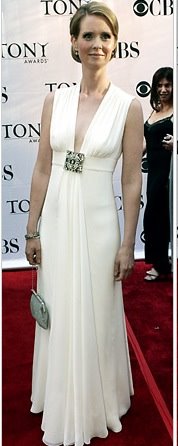 Just heard someone behind me on the phone to their mother, telling her that they just saw Cynthia Nixon. “What? No, Mom, not President Nixon, Cynthia Nixon!”
Nixon was pleasant and bland, talking about shoes (hers are comfortable so that she can last the longest at the afterparty), singing lessons and the need to nurture new writing, which seems to be the buzz phrase of the evening.
Alan Bennett came! He is so sweet. Bowtie crooked. Still here, talking in a very bumbling and bashful fashion about the success of the play and what he’s doing next. Last time he was on Broadway with a play was in 1962, with Beyond the Fringe, (“before any of you were born, I’d imagine,” he says to the room of journalists, making the considerable quotient of fiftysomethings in here very well disposed to him indeed, I’d imagine. "I haven't followed the history of the Tonys since," the '60s, he observes. "I had no idea it had become such a big deal." A reporter puts his hand up to congratulate him on the fact that The History Boys has just tied the record for most Tonys won (6) by a single play. Bennett clearly doesn't believe him - Angels in America, he thinks, holds the title. Turns out the journalist was right.
Bennett's not working on another play, because he gets so many letters about his memoir, Untold Stories, that he spends all day replying to them (“it’s not a joke, really”) and he’s unlikely to be bringing his play The Lady in the Van, to New York unless Maggie Smith comes – and she won’t come, she says, unless he plays himself in it. And he gets stagefright now, he says. “I don’t think I’d even be able to play myself.”
Tony Awards Live 3
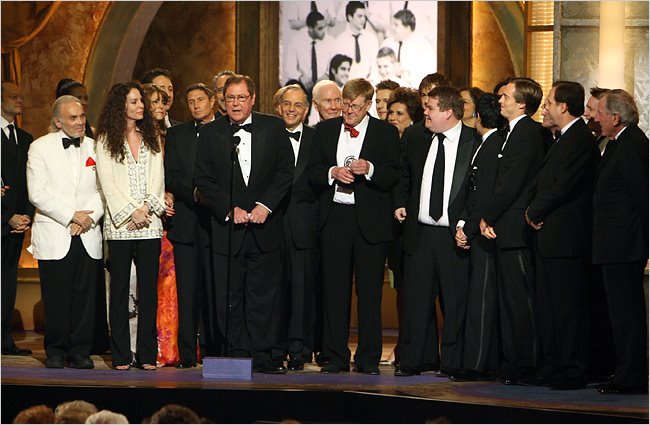
The History Boys just won Best Play. Alan Bennett, along with the producer, accepted the award...and the ENTIRE cast and crew trooped up on the stage along with them. Very short speech from Bennett, talking about how they were nervous bringing the play to Broadway and worried it wouldn't be understood by New York audiences. Actually, the night we were there, it was the sections of the audience from parts of America other than NY (the tourists from the Midwest, etc) who were hissing to each other in bafflement at the accents. Anyway. The RTE boys have just gone home, because there's no reason to stay around here any longer now - that's it for the Irish nominees. But I'm hoping they'll bring Cynthia Nixon up here, and Richard Griffiths, and maybe even Alan Bennett (unikely), so like a good little starstruck hack, I'm staying put. Plus, there are strawberries, With chocolate on them.
Poor Martin. And he looked so good in that tux...
Gad. Cynthia Nixon just came in. She's THIN. Whining about the strong lights, but otherwise pleasant. Or is that bland?
Tony Awards Live 2
First Anti-Bush joke of the evening. Actually, it's probably going to be the only one. Something about a Republican puppet. And when you've seen it (earlier on, they let me into rehearsals by mistake) being practiced over and over until it's done right, it sort of loses its magic. But still. Loud applause, etc.
Christian Hoff won best Featured Actor in a Musical and cried, and thanked the Lord, and talked to the unborn baby in his wife's womb. God. Somebody else make a puppet joke and get that man off the stage.
Oooh! Julia Roberts is announcing the Best Actor award next. G'wan David Wilmot!!!!
Update: Wilmot would have gotten the award for incredulity-at-being-here if there was one (his expression when the camera closed in on him was priceless), but Richard Griffiths won (so there, Ralph Fiennes). He gave such a long speech that they did the play-the-music-so-he'll-leave thing eventually; relished his 6000-strong audience and quoted the Walt Whitman line from the play, and I think he even sort of shrugged off the bony usher woman who seemed to be trying to steer him away from the podium. Good man! Cynthia Nixon, on the other hand, who won Best Actress, was BORING...and, as the guy from the San Fran Lesbian Gay Times beside me at the red carpet said when he saw her, where the hell was her girlfriend? And why no mention or thank you? Come to think of it, for a theatre awards ceremony, there was a depressing dearth of gay couples out there tonight. So everyone in NY theatre is straight and married? Yeah, right.
Fair play to Julia Roberts for prefacing her scripted introduction to the Best Actor award by saying to the actors in the audience "you people are insanely talented" in a very pointed fashion. A reference, I would think, to her discovery that being on stage is damn, damn hard, and not at all like film work.
What's left of the Irish hopes now? Best Play and Best Lighting Design, I think. So that's that...
Wait! Bob Crowley just won for Scenic Design - not for Tarzan, but for The History Boys. He's Irish....and begrudging with it: "Thanks very much. But between me and you, I should have won for the other one," he said.
A bit of a live blog: The Tonys, I
 Now this is what I call an Empire State View. Sixty-four stories above Manhattan, in the Tonys media room, the Empire State herself on one side, the Hudson and Central Park on the other. It’s a pretty good set-up here, with lots of food and drink and a spot with internet access for every journalist, but I’d still prefer, obviously, to be across the road in Radio City Music Hall, where they’re rattling through the ceremony at a brisk pace. Faith Healer was the first winner of the evening, with Ian McDiarmid (below) getting the award for Best Featured Actor. He gave a brief speech about how the play was one of the most musically perfect pieces for stage in the English language…wonder what all the musical people present made of that…and then came back here and talked about Brian Friel for a bit. He seemed genuinely thrilled. This is his Broadway debut, at 61. The History Boys won for Best Director and Best Featured Actress, Nicholas Hytner and Frances de la Tour respectively. He went on a rant about how English theatres got so much money from the government and American theatres should too, and she talked for the zillionth time (it wasn’t her fault, people kept asking the question) on what it was like to be the only woman in a cast of men. What did she draw on? “Sixty years.” How do the young guys in the cast regard her? “They call me J-La”.
Faith Healer lost out in Best Revival of a Play, which went to Awake & Sing. John Doyle, another British director, won for Direction of a Musical, with Sweeney Todd, and The Drowsy Chaperone seems to be winning all the other musical awards (sorry, I just can’t absorb information about musicals. It’s nothing to be proud of, I just don’t take it in.)
Heee, I think the Americans are getting a bit pissed off with all the British directors coming in here and talking about money and ticket prices and the other cold hard economic facts of theatre. John Doyle has just taken a question from a British journalist about ticket prices, and he’s answering pretty passionately (prices are rising in Britain too, becoming almost as ridiculous as Broadway), and you can just feel the boredom in the room. They should count themselves lucky they won’t have to listen to Michael Colgan talking about how he runs the Gate on a fraction of what the Abbey gets…
After the jump, some red carpet observations and pics...
This was my first time covering a red carpet do; I was late for the opening of Faith Healer on Broadway a couple of weeks ago, just getting there in time for the beginning of the play, and missing all the celebrities-and-flashbulbs activity beforehand...I did get to run up the red rug myself though - it was more panting and perspiring than preening and posturing. But that wasn't nearly as big a deal as the Tonys, for which two whole streets of midtown Manhattan were closed for 12 hours, with cops everywhere and something like 600 journalists. It was quite the rite of passage. Dozens of uniformly thin, uniformly blonde, uniformly stern-faced PR women barking us all into queues, into submission, and eventually, into place. "Place" being a tiny, tiny spot behind the barricades. Journalists stood pressed against each other, the ranks at least two deep, cameras banging into each other's heads and notebooks getting into each other's shots. Remarkably, tempers remained calm - but then, I had been placed on the...um, special interest (read: not really important to the PR people) end of the line, it seemed. Beside me were reporters from couple of LGBT publications from California, an insane woman from a Midwest newspaper, and a very young looking girl from NYU radio who, for some unknown reason, was dressed in full evening regalia and had a camerawoman with her. For radio, sweetheart. Weren't you overspending the budget somewhat? Anyway. I didn't care. These people were more fun, I'll bet, than the sharks from Entertainment Weekly and Access Hollywood, who got the premium spots at the other end of the carpet.
Lots of jostling for position and craning of necks to see if anybody important had arrived yet; for a good half hour, nothing. Thousands of fans gathered on the other side of the road, behind another set of barricades; their view was terrible, because the journalists stood between them and the red carpet. Still, they stood and cheered every tinted-glass limo and SUV that pulled up. And the limos were starting to come, and the screams of the crowd suggested that someone had arrived. Not that we could see anything. Except a seven year old girl who was chillingly skilled at the art of preening, walking nonchalantly around at our end of the carpet - turned out she was Kate Burton's daughter, waiting for her mother to make her long journey from the other end. And at our end, another odd thing was happening. And at first, it looked very bad indeed. Lots of people in evening dress - the sort of people you'd imagine should be walking the red carpet with all the other eveningfrocked people - were gathering by the door to RCMH, sort of huddling together, and being snubbed by the legions of publicists and photographers stood between them and the journalists. Looked like these people weren't allowed to walk the red rug. Looked like they were kind of forced to play second fiddle to the "real" stars. Looked like they were being sort of humiliated. Looked bad. And oh, did I forget to mention that all of these people were black?
Well, I needn't have worried. Rampant racism was not, after all, stalking the Tonys. (Although *cough* there weren't that many non-white people on the actual red carpet, as opposed to its Edge Of Shame, either. Just saying...) Turns out that the people in question were, rather, paying guests, otherwise known in the business as the lowest of the low. They'd bought their tickets, and they'd paid for their own dresses and tuxedos, and they were standing outside the venue for as long as they could in order to get a gawk at the stars with whom they'd be sharing breathing space for the evening. "You don't want to look at those people," the journalist beside me cautioned, when she saw me looking curiously in their direction. "Those people are nobody."
Saturday, June 10, 2006
Might As Well Stay Home...
 If these predictions are anything to go by, the three Irish plays haven't a hope at the Tonys later on today. Looks like The History Boys and its star, Uncle Monty, will win everything, plays-wise at least, and as for the musicals, Drowsy Chaperone or Jersey Boys or something, who cares?
Last night we went to see Adam Rapp's play Red Light Winter at the West Village theatre, the Barrow. It's a good spot, and the plays I've seen there have been of a consistently high quality. But, like most of the theatre I've encountered here, they've always had to them a hint of compromise, of second-best. Standards here are just lower, sloppier, without, it seems, anybody really realising or caring. Hyperbole is the critic's best friend here. They go crazy for anything sentimental, moody, angry, no matter how shallow or manipulative the employment or portrayal of those emotions may be. Red Light Winter is an o.k. play, and I'm glad I saw it, but it didn't deserve the glowing reviews it got in the establishment press here. It's about two best friends who sleep with the same prostitute in Amsterdam; one of them, a tortured playwright, falls in love with her, while she falls in love with the other, a macho idiot. The dialogue is snappy (too snappy at times) and there are genuinely powerful moments. And it gave me a chance to hear Tom Waits' Tom Traubert's Blues again, and reminded me to download all of Small Change this morning, and listen to it, so that's good. And yeah, good performances. But claustrophobic, and underdeveloped, and abandoned just when things were getting interesting. So all in all, another NY theatre experience. It's only when it comes to theatre that I ever really miss Dublin.
Friday, May 19, 2006
Red Carpet Day at the Lieutenant
 This is too funny. The publicist involved is either brilliantly, savagely ironic, or hopelessly oblivious.
Here’s a sampling of quotes from reviews of Martin McDonagh’s The Lieutenant of Inishmore”. “Blood winds up on almost every surface,” says The New York Times. “The blood-soaked events…make Sweeney Todd look like a stroll down Park Lane,” says CurtainUp. “I have never seen so much blood onstage,” says another. Pretty much every critic that has reviewed the play has resorted to use of the term “bloodbath”.
And what’s happening at the theatre where it’s running next Tuesday? A blood drive for the New York Blood Centre. Apparently this centre’s mission is to collect 2000 volunteer blood donations a day to support transfusion needs in close to 200 NY and Jersey hospitals. Have they thought about just putting a couple of bowls under the stage for the rest of the Lieutenant run?!
There’ll be free tickets to the play for the first 50 donors. If only my blood was pure….
Monday, May 15, 2006
On Pints and Ponchos: Shining City in the New York Press

There’s an odd interview with Conor McPherson in Sunday’s New York Times. Or maybe it’s not odd, and it’s just that the American approach to interviewing is very different. McPherson flew to New York early so that he could give this interview, yet the writer, Jason Zinoman, quotes him only a handful of times (eight short quotes in a 1200 word pieces), opting instead to ruminate at length about the playwright’s near-fatal battle with alcoholism (he collapsed at the opening of Port Authority in 2001, and was subsequently unconscious for three weeks with a dangerously inflamed pancreas), and about the place of alcohol in his plays. I’m not saying that this isn’t interesting, and McPherson is willing to talk openly about it, but it’s such a bloody predictable approach. Finishing up, of course, with the obligatory meditation on the centrality of drink in Irish culture. Again, I’m not saying this shouldn’t be there, but there was room in a piece of this length to explore, in more depth, other aspects of McPherson’s playwriting practice and of the creation of Shining City. Like, for example, the fact that it came largely out of his own experience in therapy following his breakdown. There’s a mention of how dysfunctional and crazy therapists are, but I would have liked to read a little more about the creation of a play out of that situation. Also, is it just me or is there something drearily voyeuristic about the way that Zinoman goes to Neil Jordan for a quote about how drunk McPherson used to get and how much he used to drink by himself? And getting the “things are better now” quote from McPherson’s wife; if the rest of the interview was sufficiently probing and revealing of its subject, this sort of padding would not be needed, because the reader would know that McPherson drank too much, and that he’s more balanced and happy now. In fact, the little that Zinoman gives us of McPherson’s own words already shows this, so why the other quotes? I think it’s mere gimmickry. John Lahr of the New Yorker often talks to the family and friends of his subjects when he’s writing his long profiles, but there’s never a sense of redundancy or of going over already-covered ground with those quotes. Everything has its place, and what’s built up as a result is a full and far-reaching portrait. I think the NYT has merely glossed over McPherson. He’s been sober for 5 years, so why a whole article about his drinking? (Not to mention his “kinky red hair”…spare us.)
Speaking of the New Yorker, Hilton Als gives Shining City a pretty brisk seeing-to in his review. It’s not entirely at the other end of the spectrum to Ben Brantley’s NYT gushfest, (“in terms of construction…as close to perfection as contemporary playwriting gets”) but it’s certainly not a glowing response. Why he feels the need to devote a long paragraph at the beginning of the review to an utterly unrelated actor and director, Charles Laughton - best known as Quasimodo in the 1939 film The Hunchback of Notre Dame – absolutely baffles me; if he wanted to discuss Oliver Platt’s distinctive “way of moving through space”, why not get straight to it? (I’m not convinced that Platt was that comfortable in the role anyway; I think his onstage awkwardness might have stemmed from a genuine discomfort with the role of an Irishman.)
Als praises all four actors, and his point that listening, much of which is required of this cast, is one of the hardest things for an actor to perform, is a very good one. But I can’t agree with his argument that O’Byrne’s role is technically the most difficult because he must “hold up a mirror to two confused souls without conveying his own character’s confusion in their presence.” Our gradual realisation of Ian’s confusion and internal chaos is essential, and O’Byrne must guide us towards that realisation in the scenes he shares with the other actors. Which I think he does without difficulty, yet Als maintains that he (Als) didn’t intuit that confusion until near the end. Maybe he was too distracted by Platt’s “poncho” (it’s a windcheater, for Christ’s sake…)?! Oh, ok, that’s just petty. I usually like Als’s criticism a lot, and I agree with his final analysis of the play, that it comes across “as an undeveloped first draft”. And I agree that the actors, most of them, turn in strong performances, but I see their strengths in different places. I certainly can’t share Als’s adoration of Oliver Platt, and I think that Peter Scanavino deserved more credit than he was given in this review (in fact, he was not even mentioned…was his accent too strong?) Great photo, though, by Steve Pyke (above).
Thursday, April 13, 2006
Birth was the death of him
 "I was born on Friday the thirteenth, and Good Friday, too. My father had been waiting all day for my arrival. At eight p.m. he went out for a walk, and when he returned, I had been born."
Samuel Beckett, letter to George Reavey, 1972.
*
"He was a pale, sickly baby, long and thin, crying constantly, decidedly different from his robust and placid older brother. He gave his family some concern during his first weeks of life, but was never in any serious danger."
Deirdre Bair, Beckett, 1978
*
"There has been a lot of debate as to whether this was or was not the true date of his birth. His birth certificate records the date as the thirteenth of May, not April. And his father registered the event on June 14 - a month later, it is argued, than he would, or at least should, have done, if the birth had been in April. So it has been claimed that Beckett deliberately created the myth that he was born on Friday the thirteenth - and a Good Friday at that; a fitting date for someone so conscious of the Easter story and so aware of life as a painful Passion.
[...]
More interesting, and far more revealing, is how Beckett spoke about his birth. He claimed to have clear prenatal memories of life within his mother's womb. The womb is commonly thought of as a sheltered haven, where the fetus is protected from harm. Occasionally, that is how it is reflected in Beckett's writing; in the poem 'Sanies I', for instance, which looks back to his birth, he writes nostalgically, "ah to be back in the caul now with no trusts / no fingers no spoilt love." Yet the memories that, as an adult, he claimed to have of the womb, deriving probably from the period shortly before birth, were associated more often with feelings of being trapped and unable to escape, imprisoned and in pain."
James Knowlson, Damned to Fame: The Life of Samuel Beckett, 1996.
Monday, March 27, 2006
Please turn off all egos before the show
 Probably out of some tendency towards masochism, I sometimes listen online to Ryan Tubridy's radio show (RTE) on weekday mornings. It's a pretty pointless exercise, because it in no way helps me to keep up with what's in the news at home - now that he's got his primetime radio show, Tubridy has abandoned any of the pretensions towards being a thorough or clued-in commentator that he might have exhibited a couple of years ago, when he was being energetically touted as the biggest talent in Irish broadcasting. Now that he's secured the fat salary, he doesn't seem to feel the need to bother making any of those noises anymore. He's free to wallow, instead, in his own considerable collection of prejudices and pomposities, preaching from the confines of his narrow range of interests and expertise, and dealing with everything else through a combination of small talk, generalisation and downright bluster. He's been compared over and over to Gay Byrne, but he has none of Byrne's intelligence and empathy. He's much closer in style to Val Joyce, whose absent-minded ramblings on Late Date are punctuated only by cranky outbursts against the perceived errors of his producers (which usually seem to consist, rather, of Joyce's inability to put a CD into the machine). They also share a taste for truly terrible music, the sort of tunes you might hear at an afternoon disco in a nursing home.
And then there's the arrogance. Tubridy substitutes arrogance for authority and for argument at every turn. And usually it points to something even less pleasant; witness the slow emergence into daylight of what can only be described as homophobia last month, as he tried for weeks to get out of going to see the film on which he passed snide comment nearly every day, and about which his listeners had plenty of thoughtful comment to make: Brokeback Mountain . Instigating a backlash against the hype is one thing, but it's difficult to take seriously the criticisms of someone who seemed either too lazy or too apprehensive to actually go and see the film. When he eventually did, his comments were just as snide and even more telling, despite the fact that he grudgingly admitted he thought it good; good, that is, apart from the love scenes between the two men. Gay love scenes just weren't for him, he said in a tone of undisguised distaste. He implied that he really didn't see the need for that sort of thing to actually be shown. And you can be damn well sure that he made no apologies for this position. Tubridy seems to see his conservativism as something quirky, daring, different; it's not. It's random, shallow and unconsidered, just like his broadcasting.
This morning he was on again about one of his cripplingly dull hobbyhorses; mobile phones and their use in public places. This sort of bitching was funny in 1999, when mobile phones were new; now, it's just embarrassing. Yet Tubridy makes the same jokes, does the same dreary imitations of phone users, almost every morning. And this morning, he started the show by hailing Ralph Fiennes not only as one of the greatest actors of his generation (questionable, very questionable) but as a hero. Why? Because, apparently, when the mobile phone of an audience member rang during the opening minutes of his performance at the Gate in Brian Friel's Faith Healer , Fiennes broke out of character and barked into the audience, "turn that fucking thing off". Hero, says Tubridy. How, exactly? If Fiennes really did this, it's deeply unprofessional, an insult to the theatre that's hosting him (not that Michael Colgan will give, well, a fuck), to the audience that paid to see him in a role, not in a self-indulgent rage, and to the playwright, the director and the other actors who've worked on the play. Breaking out of character like this is the most unthinkable thing for an actor to do - I've only seen it once, also at the Gate, and in this case it was justified, because the actor in question (Declan Conlon, in The Book of Evidence three years ago ) saw an elderly woman taking ill in the audience and very reasonably believed she was having a heart attack - he then called for someone to help her, and after she'd been taken out (she had had an attack of some sort, but recovered) sat down, took a moment to regroup, and then went seamlessly back into full-flow as his character. Actually I thought that was somewhat heroic. But Fiennes, carping and sniping about something that, while undesirable, just happens sometimes and is hardly a disaster in the scheme of things, something that, while understandably distracting to an actor, does not merit that sort of behaviour, swinging the attention of the audience back to him as The Star (as though it weren't sufficiently there already) instead of to Friel's character...that's not heroic, that's histrionic. And Tubridy, who happily admitted a couple of weeks ago that his trip to Faith Healer was the first time he'd been to the theatre in years , laps it up and read it as some badge of Fiennes' legend, like he's Brando up there, or even Donal McCann, who would never have pulled that sort of shit, who would never, whatever his flaws, have substituted conceit for character, arrogance for art. He would just have done the job. If Fiennes can't do that, I don't care about his fame. And if he pulls that kind of stunt on Broadway when the play comes here later this month, I'd bet good money that the response will be a lot less sympathetic.
Friday, February 17, 2006
"You were saying something nice about me, I can feel it."

I found this photograph of Samuel Beckett and his American publisher Rosset online. It's by Bob Adelman. I also found this snippet, which shows Beckett at his spiky best:
The door is imperceptibly ajar. Thus reads a stage direction in one of Samuel Beckett's plays. One director, endeavoring to honor Beckett's meaning to the letter, labored over this direction for many minutes, painstakingly experimenting with varying degrees of ajarness. Eventually Beckett himself, watching in disgust, strode onto the stage and slammed the door shut. "But it says ajar," the director protested - whereupon Beckett turned on him and snarled, "It also says imperceptibly!"
The title quote, by the way, comes from Beckett's 1947 play Eleuthéria., unproduced and unperformed, and only published after much trouble was taken by Rosset and others. It's not his best play, but it just might be his most interesting, and I think Rosset is right...Beckett would eventually have consented to having it published, and maybe even performed, if he had lived longer.