Have been travelling...and trapezing...will update soon.
Monday, June 26, 2006

Thursday, June 22, 2006
7pm EDT: This kid just got a year older in Ireland...
 ...but she's still 26 in New York! Ah, these precious five hours of remaining youth. How shall she spend them? Finishing her novel? Considering her future? Mindlessly surfing online?
Yeah, probably the last one.
Doyle and Enright give The Irish Times what for
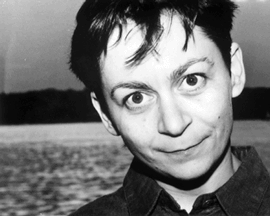 It's a pity that Eileen Battersby, Literary Correspondent of The Irish Times didn't elaborate on the barbed comments directed at that newspaper, and at Irish literary critics - that is, directly at her, among others - by Roddy Doyle and Anne Enright during their public interview as part of last week's Dublin Writers' Festival. Perhaps it was just mentioned in passing, but this is all her report had to say on the matter:
Both he and Enright shake their heads over what they see as the ongoing stupidity of The Irish Times, all that is wrong with society is invariably reflected in its cosy pages. They also agree that there are currently 40 good Irish writers and no good literary critics, "the film critics are even worse."
 Firstly, 40 good living Irish writers is too generous an estimate. It really is. It sounds like a figure pulled out of the air, possibly as a joke. I can think of maybe 15 good Irish writers. Maybe, just maybe, 20. In fact, I'm going to try and write a list, and see how many I can come up with. I'll update later.
Secondly, on the cosiness of the Irish Times: Fair play to Battersby for mentioning the comments, I suppose, even if she doesn't do much more than tack it onto the end of her article. I have to wonder whether Doyle and Enright gave a fuller idea of what they meant by cosiness when they used that word (if they used that word - it's not in quotes). Were they talking about the newspaper as a whole, about the arts coverage, about the books pages, about the opinion pages, about the Saturday magazine, to which Enright herself is a reasonably regular contributor? (It looked like she might have been taking over Roisin Ingle's column for a while there.) It's difficult to respond to their criticism without knowing.
Thirdly, and related to this last point: the dearth of good Irish literary critics. I have mixed feelings on this. Ireland does not exactly boast a vibrant and strengthening critical climate where literature and the arts are concerned, but I don't for a minute agree that there are no good Irish literary critics. Again, it would be good to know what they mean by critics - if they're talking just about critics of fiction, or if they mean critics of every form of writing, from poetry to history and biography. It's unclear, too, whether they refer to academic critics, novelists who review novels, journalists who review anything they're handed, or a mixture of all three. Even if it is a mixture, I can think offhand of examples from all three fields who I count as fine critics. Again, I'll try to update with a fuller list, but here are some critics, or reviewers if you want, who publish in Irish newspapers and journals, and whose writing I respect: Nicholas Grene (academic). Colm Toibin (novelist). John Banville (novelist and former literary editor of the IT). Declan Kiberd (academic). Dennis O'Driscoll, Peter Sirr and Vona Groarke (poets). Susan McKay (political journalist and book reviewer). William Wall (novelist, who wrote brilliantly on Irish poetry in the magazine the Shop a few months ago). There must be others, and I know I'm sticking too closely to the reviewers of the Irish Times, but really where else do you look for a serious and dedicated book review section? There's also the Irish Book Review, which has some good reviewers, but it seemed, in its early issues at least, overly cliquey and unlikely to display any real diversity or unpredictability in its views on Irish books. Also, the reviews in those early issues were just plain poor; often badly written, and either petty or parochial.
On film critics: Donald Clarke is very good. Apart from him - and I doubt Enright and Doyle were even thinking of the internet as a valid source of reviews or criticism - I look mainly to blogs for reviews of film and for other criticism. But it's true, there's nobody in Irish film criticism of the calibre of, say, Anthony Lane. That said, what real outlets would there be for someone writing longer, more considered reviews like his? (I haven't read Film Ireland for a while. Maybe it has reviews like that? I don't know.)
I notice they didn't touch on theatre criticism, nor would I expect them to in this context. That's a whole other day's work.
I'd say that Doyle and Enright made for a formidable team once they got going together on this. They're both outspoken, eloquent, sharply intelligent and utterly intolerant of bullshit. If they were given an hour to talk about newspapers and literary criticism in Ireland, I'd be on the next plane home to hear them. I'd also hope for a slightly fuller account of the debate in the paper the next day (or six days later, whatever you can manage), but that's just me. And, like I say, the comments were possibly just part of a really rapid-fire discussion, and were not dwelt upon long enough to merit a fuller mention.
Some other features of the interview (Enright interviewed Doyle), from Battersby's article today:
• Doyle didn't suffer fools from the audience gladly. He doesn't suffer windbags gladly either. Or maybe he just didn't suffer audience members, full stop. A woman wanted him to know she didn't enjoy The Commitments; he seems not to have bothered even to reply. A man wanted to know about his views on "religion and churches". "I'm an atheist," Doyle responded bluntly. That was the end of that.
• Doyle admitted that the actor Ger Ryan's interpretation of his character, Paula Spencer, in the stage version of his novel The Woman Who Walked Into Doors had made for a "different, stronger" version of the character and that, as he wrote the sequel to the novel (which will be published in September), he was aware of the challenge this posed to his own characterisation of her. At least, I think that's what he's saying. Maybe he's talking about the stage version, which he helped to adapt. Again, it's a little unclear. But if this is the challenge he's talking about, it's a very interesting one, and I guess one that other authors have faced too, as they write sequels, or the next book in a series.
• He talked about the number of "wrecked, baldy old guys" who come up to him in the street and tell him that he used to teach them. Others, or maybe the same guys, are "recovering heroin addicts...the ghosts of young kids he used to teach," writes Battersby.
• Enright came across, writes Battersby, "as a harassed housewife on temporary day release from her children," and complains that she has no time to read. But she's shrewd and alert as an interviewer, and knew "how to turn an interview into an apparently casual conversation. She [was] also asking Doyle the right questions." Another reason why she should write for the Irish Times, then. Sign her up!
• Doyle would love to live in New York. You can stay with us, Roddy. Just for a couple of days, mind.
• The recent changes to Ireland's population, which have seen large numbers of immigrants come to the country over the last five to seven years, have created an unexpected bonus for Doyle, who's a pretty recognisable figure in Ireland, as writers go: "I can walk down the street without every tenth person asking me if I'm Roddy Doyle." He also mentions in passing that he's learning Polish. Is he? Was this said ironically (he also said he's the only person on his bus route now who speaks English) or in dead seriousness?
• As was already known (it was discussed at some length in Angela Bourke's biography, and in Doyle's book Rory and Ita), Doyle's second cousin was Maeve Brennan, the famous Irish New Yorker writer, who wrote the magazine's Talk of the Town column during the 1950s and 60s under the pseudonym of the ”Long-Winded Lady”. Doyle spoke a little about her on Friday; he was 14 when she came to stay in his family home for a few months. That would have been around 1972, when things had begun to fall apart for Brennan. She rarely ate, stayed in her room with the curtains closed, and wrote furiously. Doyle, on Friday, remembered her as "incredibly elegant and eccentric", bewildered by an Ireland she no longer knew. He didn't speak to her about writing, because he wasn't interested in it at the time.
• Enright talked about something interesting: the emergence of an underclass in Dublin, or in Ireland (not clear which), and how this is something different to the working-class. Again, more on this would have been fascinating, but perhaps space didn't allow it...or something... anybody who was there, please comment!
• Doyle on the linguistic gift of the working class (in Dublin, I think): "A well-aimed working-class insult can do in two sentences what it would take a barrister three days to do."
• After they made their '40 good writers' remark, the audience got involved, shouting out the names of other Irish writers to see what Doyle and Enright had to say about them. Battersby remarks that "the expected [were] praised". It'd be good to know who the praised and the unpraised were, but only one is named in the piece: Jennifer Johnston, whose work Doyle said he loved. It's the duty of the writer, he said, "to produce good work."
Yeah, and it's the duty of the literary journalist too.
That's Stephen James Joyce to you...
 What do we think of Stephen Joyce around these parts? Sorry, Stephen James Joyce, to give him the full name upon which he insists. Well, we think that it would be fascinating to see SJJ’s response if all the scholars and critics stopped showing an interest in Joyce’s writings, and in his life, all of a sudden; if the Joycean industry drew to an unceremonious halt. And people stopped reading, and stopped analysing, and stopped thinking about SJJ’s grandfather. Because that’s what you want, isn’t it, SJJ? That’s what you mean when you tell D.T. Max, in this week’s New Yorker, (ETA: now last week's...this has been on the backburner for a while, sorry) that academics are like “rats and lice” and “should be exterminated”, isn’t it? That academics are “people who want to brand this great work [Ulysses] with their mark”, and that you “don’t accept that”?
But you like your own mark on Ulysses, and on the rest of the Joyce estate, to be clearly visible. In fact, along with the Great Wall of China, it can probably be seen from space. That’s unusual for a big, grubby set of fingerprints, but you’ve proven that nothing’s impossible. You say that if you had “the energy”, you’d write a book about your grandfather, and about how he was treated by Ireland. You don’t mention whether or not you think yourself to have the talent to do that, though. To write a book. Funny that you never have. Don’t you feel capable? Do you wish you were as famous as your grandfather? Could that be what all of this fuss is about?
Below, some highlights from Max’s excellent New Yorker piece, which I think give an insight into the mind of the man.
In 1988, he took offence at the epilogue to Brenda Maddox’s Nora, a biography of Nora’s wife, which described the decades that Joyce’s schizophrenic daughter, Lucia, spent in a mental asylum. Although the book had already been printed in galleys, Maddox, fearing a legal battle, offered to delete the section: the agreement she signed with Stephen also enjoined her descendants from publishing the material. Shortly afterward, at a Bloomsday symposium in Venice, Stephen announced that he had destroyed all the letters that his aunt Lucia had written to him and his wife. He added that he had done the same with postcards and a telegram sent to Lucia by Samuel Beckett, with whom she had pursued a relationship in the late nineteen-twenties.
SJJ wrote at the time that he had not destroyed any papers or letters in his grandfather’s own hand – “yet”. But in the 1990s, he persuaded the National Library of Ireland to give him some Joyce family correspondence that was scheduled to be unsealed. Scholars worry that these documents, too, have been destroyed.
In 2004, the centenary of Bloomsday, Stephen threatened the Irish government with a lawsuit if it staged any Bloomsday readings; the readings were cancelled. He warned the National Library of Ireland that a planned display of his grandfather’s manuscripts violated his copyright. (The Irish Senate passed an emergency amendment to thwart him.) His antagonism led the Abbey Theatre to cancel a production of Joyce’s play “Exiles”, and he told Adam Harvey, a performance artist who had simply memorised a portion of “Finnegans Wake” in expectation of reciting it onstage, that he had likely “already infringed” on the estate’s copyright. Harvey later discovered that, under British law, Joyce did not have the right to stop his performance.
Ok, let’s pause here to think about that last one. By memorising a part of of Joyce’s work, an artist had violated copyright? D.T. Max’s article maintained a tone of appropriate distance from its subject, and somehow did not at any point erupt into exclamations of disbelief and disgust, but I don’t know for the life of me how he managed to resist the temptation. Probably David Remnick himself had to stand him a couple of strong brandies. You have to admire Max for writing this article without once using the words “insane”, “control-freak” or “roaring maniac”. Not about anybody in particular, that is. Just saying.
Let’s go on.
Stephen has also attempted to impede the publication of dozens of scholarly works on James Joyce. He rejects nearly every request to quote from unpublished letters. Last year, he told a prominent Joyce scholar that he was no longer granting permissions to quote from any of Joyce’s writings. (The scholar, fearing retribution, declined to be named in this article). Stephen’s primary motive has been to put a halt to work that, in his view, either violates his family’s privacy or exceeds the bounds of reputable scholarship.
Quoting from unpublished letters is one thing; though I’m firmly of the belief that the contents of unpublished letters can further the understanding of what drove and shaped an author’s work, and matter deeply for the development of serious scholarship around that work, it’s fair enough that an author’s estate gets to lay down conditions about the use of that content. They are personal documents, after all. Most estates are a lot more reasonable than SJJ, but I accept that, where the letters are concerned, his is the final word. However, the matter of quoting from Joyce’s published work is an entirely different one. The idea that he would prevent scholars, critics and artists from quoting from Dubliners or Ulysses on the grounds that such use somehow “violates his family’s privacy” begs further explanation. As does the notion that SJJ would somehow know, even before reading requests from scholars for the use of such quotes, that any use whatsoever would “exceed the bounds of reputable scholarship”. More from the whirring Eureka-vortex of SJJ’s brain, please! Here’s a suggestion for the next step: stop bookstores stocking the books, or, at the very least, stop them from displaying the books on their shelves in a way that the titles are clearly visible. Because that’s sort of a violation of copyright, too. And, come to think of it, so is the act of reading Joyce. Especially if you’re one of those people whose lips move as they read. Or, if you sometimes, for some reason, read aloud. For example, if you were reading to your precocious offspring from the pages of Joyce’s children’s book, The Cat and the Devil, based on a letter-story that your grandfather sent to you when you were a boy. Yes, don’t worry, SJJ, everybody knows that The Cat and the Devil, like all of Joyce’s writings, is really, secretly, essentially, at base, all about you! Don’t worry. You’re at the centre of everything to do with Joyce. As Max, in perhaps the article’s most pointed paragraph, points out:
The two-decade-long effort has also been an exercise in power – an attempt to establish his own centrality in regard to anything involving his grandfather…as he put it to me during two phone calls that he recently made to me from La Flotte, “What other literary estate stands up the way I do? It’s a whole way of looking at things and looking at life.”
And just a couple more samples of SJJ’s inimitable style:
When turning down a request for permission from an academic whose work was going to be published by Purdue, he said that he objected to the name for the university’s sports teams: the Boilermakers. (He considered it vulgar.) Michael Groden, a scholar at the University of Western Ontario, spent seven years creating a multimedia version of Ulysses, only to have Stephen block the project, in 2003, with a demand for a permissions fee of one and a half million dollars. (Before Stephen controlled the Joyce estate, such fees were nominal.) Groden’s sin was to have praised Danis Rose’s edition of Ulysses as “confident and controversial,” in a reader’s report for Rose’s publisher; he had also helped the National Library of Ireland to evaluate some Joyce drafts prior to acquiring them.“You should consider a new career as a garbage collector in New York City, because you’ll never quote a Joyce text again,” Stephen told Groden.
This week, Laurence Lessig, a law professor at Stanford, will file a suit against SJJ in United States District Court. He’s acting on behalf of the author Carol Loeb Shloss, whose book on Joyce’s daughter Lucia was published in 2003. The book was about Lucia’s mental illness, and before it was published, SJJ made clear to her publisher that he would sue if she quoted from copyrighted material. The book was published with cuts. While Shloss was fighting with SJJ, she met Lessig, a copyright specialist, who agreed to take on her case pro bono. He wants to show, to quote Max, that “distended copyright laws [are] not in the public interest.” His case this week will be the first to accuse a literary estate of “copyright misuse”.
Shloss’s book, it should be said, is by no means an example of why scholars should be allowed greater leeway when it comes to quoting from copyrighted Joyce material. There’s something decidedly sensationalist about her project; to probe into the mental illness of Joyce’s daughter is hardly an exercise in Joycean scholarship. So in a way her case is not ideal as a challenge to SJJ’s grip on the estate. But then, Lessig’s not challenging the grip itself so much as he is challenging the way SJJ wields that grip. During Shloss’s attempt to publish her book, she and her publisher received letters and phone calls of a threatening manner from SJJ. She alleges he was practically spying on her at one stage, and that he made concerted attempts to block her research - by removing documents from libraries, for example. It’s against that kind of behaviour on the part of an estate that Lessig is taking a lawsuit. Intellectual property specialists think he’s unlikely to succeed; the precedent such a success would set for estates would be too drastic. But it’ll certainly be an interesting one to watch.
Things You Really, Really Need To Know Today. Really.
• You know what the gays have most pride in this week? Soon, if their cunning plan for marriage rights works out, they'll be able to marry snakes. [Wall Street Journal's Daniel Henninger, six comments from the end, likely only half in jest.] Lucky bastards. Below, Stephen Colbert tells it his way. [YouTube]
• Why, oh why, must America fall for the Victoria Beckham thing? Having emigrated largely to get away from endless magazine covers showing her bones-where-no-bones-should-be, now I have to see her all over the newsstands (ok, cyber-newsstands) here, too. At least until her withered internal organs finally collapse in about a year's time. [Hollywood Tuna]
• Neil Jordan's new film is called The Brave One and his method as a director includes much jiggly-paunch-pacing, head-rootin' and grumpiness to nosy onlookers. And having cars towed away at 7 a.m. [The Reeler 1 and 2]
• Zahara Jolie-Pitt is going to nut that new kid, first chance she gets.
• Gawker puts Makey-up-Million-Pieces writer James Frey on suicide watch. Suggestion: a quick way to end it all would be to cycle the wrong way up East 88th crash-bang onto Neil Jordan's set.
Wednesday, June 21, 2006
Oh, to be twelve again...
 You've got to love this picture from last night's Irish premiere of The Wind That Shakes the Barley. Look at the big red cheeks on that little girl taking the close-range photograph of Cillian Murphy! She's finally face to face with her poster-boy, and she's only scarlet, like...
By the way, you can see a trailer for the film here.
Alice Munro to retire?
 Via the Elegant Variation comes very sad news: Alice Munro is expected to announce tonight, at a fundraiser in Toronto, that she has written her last book.
Munro is scheduled to give a reading at a benefit and book launch for Writing Life, a PEN Canada anthology of essays from 50 Canadian and international authors that is scheduled to hit stores July 1. In her contribution to the volume, Munro cites a tremor in her writing nerves in the face of constant interruptions and advancing age. (She will be 75 next month.) She says she can quit writing "in the interests of a manageable life" and with the knowledge that it's rare for outstanding work to be produced in a author's later years, "so one or two books fewer won't really be anybody's loss."
Many will beg to differ.
She is a master of the short story, and her work, in its sober, exact beauty, recalls that of another writer whose pen fell silent too soon, John McGahern. Her next book will be her 13th, another book of short fiction, which is due for a November release. Here's what the MacDowell Colony had to say this year as it awarded her its highest honour, the MacDowell medal:
"Reviewers have often compared Munro to Chekhov, and this is no overstatement. When you close a book of hers, you know a lot more about what it means to be human."
If the rumours are true, her voice will be much missed.
RTÉ and the Arts Council: Going through the motions
 This just in from the Arts Council; the meeting between its director, Mary Cloake, and the Director General of RTÉ, Cathal Goan, took place yesterday. I accept that it's perhaps too much to expect concrete results from just one meeting, but I don't see anything in this press release about a follow-up meeting, and I see little sign, in this outline of the discussion, of concrete promises being given by RTÉ about its future coverage of the arts. Reading between the lines, it looks like little more than a call-and-answer session of the appropriate noises. The noises the Arts Council knows it has to make in this situation, and the noises that RTÉ knows it has to make not to invite more negative publicity. There was plenty of affirmation, and reiteration, and talk of high priorities, but there's nothing new, and nothing binding, in the statements Goan was cornered into trotting out in yesterday's meeting. Saying that the appointment of an arts correspondent is a high priority in no way obliges RTÉ to do anything about making such an appointment. This is pie-in-the-sky stuff. Given that it does not depend on the Arts Council for its funding, RTÉ was hardly even obliged to attend the meeting when it was called by the Arts Council, and it certainly was not obliged to provide Cloake with answers, and with anything other than vague assurances. And it shows.
The Arts Council raised the serious concerns of the arts community about changes in the RTÉ Radio 1 schedule and the potential downgrading of arts coverage on RTÉ. The Arts Council urged RTÉ to maintain arts broadcasting in the mainstream of coverage rather than solely at marginal times.
RTÉ reiterated its absolute and ongoing commitment to the arts across all its broadcasting services and affirmed that the arts will remain a key priority. RTÉ said the Radio 1 autumn schedule was being finalised. RTÉ is confident that its service to the arts in that schedule will address the concerns expressed by the Arts Council.
RTÉ also said the appointment of an arts correspondent was a high priority.
The meeting discussed the complementary responsibilities of both organisations in supporting the arts, a wide range of joint initiatives, actual and potential, and the central value of the arts in a changing Ireland.
Tuesday, June 20, 2006
Rattlebag
The Rattlebag petition is well on its way towards the 1000 signatures mark - it looks like around 100 people a day are adding their voices to the protest. Do so now, if you haven't already! And pass the message on!
Nobody's saying Rattlebag is perfect as an arts programme, but RTE needs, and deserves, to be shown just how many people are frustrated and disappointed by its rescheduling decisions. A lot of those who have signed this petition are also using it to express their dismay over the axing of the Mystery Train (which, this evening, featured a brilliant and zany monologue by Kelly about when Bob Dylan comes to stay...).
Droit de Suite...but not tout de suite
 The Irish Government has announced the introduction of an Artists' Resale Right, otherwise known as droit de suite (right of continuation), which provides for loyalties to be paid to visual artists - and potentially also to their heirs - upon the resale of their work.
However, it's taking a staggered approach to the introduction of the legislation in question; instead of bringing the legislation in fully (and thereby enacting the EU directive which, by right, should have been enacted before January 1st of this year), the Minister for Enterprise, Trade and Employment has put in place "temporary measures" which will allow artists to benefit from the Artists' Resale Right "in advance" of full legislation. The Department will continue, as planned, to introduce a new Act of the Oireachtas dealing with Intellectual Property, through which the EU directive will be properly implemented, but because that legislation will not be passed for at least another six months, and because it involves "complex matters" which can not be immediately addressed, these temporary measures are being introduced in the meantime. For the benefit of artists.
And if you believe that explanation, then the disingenuous hype of the last seven days, in which a crooked politician was championed as the greatest friend to the arts since Lorenzo de' Medici, has obviously achieved its desired effect. This is not a touching display of State sensitivity to the arts. It's not even a touching display of legality. Well, legal it is, but just about. What's on display here is the naked back of the Government being covered, once again, with shabby haste.
Here's why. The EU directive on the Resale Right is something about which the Government has known for more than five years at this stage. There was an official deadline for the implementation of that directive, and, surprise, surprise, that deadline (1st January 2006) was allowed to pass. That is, the Government failed to meet it. And the artist Robert Ballagh was entirely within his rights to challenge the Government on this, and he did. He is currently seeking damages from the State due to its failure to do what the EU directed it to do, and introduce full legislation on this issue. Ballagh is claiming damages for revenue lost after the deadline - revenue, that is, which he would have earned from the resale of his work had the directive been properly enacted. Or enacted at all.
And guess when Ballagh's case was due to be heard? Next week. And hence the rushed stopgap measure. Because if a court had found in Ballagh's favour - and it's hard to find any reason why it would not - then the outcome of that case would have implications for all artists whose artworks were resold for more than €3000 since January 1st. Whether Ballagh's case now collapses entirely, or whether he can still sue for revenue lost between January and June, is not yet clear- maybe someone better versed in legal matters can advise on this in the comments. But what is clear from looking at this interim legislation is that the Government has wilfully failed the artists whose rights it has been instructed to protect. These measures meet only the bare minimum of the requirements set out by the EU Directive. They come straight from the bargain basement of Government policy. And they don't inspire much confidence in the shape of the fuller legislation to come. Two of its most charming features:
• A work must be sold for €3000 before Resale Rights (up to 4% of the sale price) kick in. Lobby groups had suggested the much fairer figure of €1000. And just how fair that figure is becomes clear when you look at the thresholds operating in other countries where droit de suite is a given: in Finland, it's €252, in Germany €51, in France just €15. Anybody who is familiar with the Irish art market and with art auctions will know that the scene is small and not hugely competitive, and that you're not at all unlikely to pick up a painting by a significant contemporary artist at, say, the Irish Art Sale at James Adam, for less than €3000. A huge number of artists are going to be left without royalties if this threshold is maintained in the actual legislation. Which really makes a mockery of its introduction in the first place.
• In other fields, artists are protected by copyright. Copyright lasts throughout the artist's life and for 70 years after their death. The EU advised that the Resale Right should be implemented in a way which mirrors the terms of copyright - but left the matter of the actual duration up to individual member states. The Irish Minister has decided, in this implementation, to cut the 70 years clause and limit the right to the artist's lifetime, apparently ignoring the fact that droit de suite was first created as much to benefit artists' heirs as to benefit artists themselves. Perhaps the Government cannot be blamed for baulking at the idea of the full 70 year duration, but that it is not obliged to include a posthumous period in the legislation in no way justifies a complete exclusion. A 20 or even 15 year period, for example, would see to it, say, that any young families might be provided for in some way after the death of an artist parent. It's well known that the work of an artist often soars in value after his or her death, and not difficult to imagine a case where a dead artist's family could face financial difficulty, even as his or her work fetched increasingly high prices at auction.
It's not surprising to see the outspoken Ballagh as the head of this campaign, but I think in a way it's unfortunate, or at least seems a missed opportunity - he's not, after all, representative of the group of artists who are most in need of Resale Rights. He makes real money from his art, and doesn't live in poverty - or if he does, he's the first artist driving a beautiful convertible while also living in poverty that I've ever seen. I admire him for taking this case, but I can't help wishing that he was joined by an artist nearer to the other end of the income scale, someone for whom the droit de suite could be the difference between poverty and subsistence, rather than between less profit and more. Such a case would serve to hammer home even more vividly the need for this legislation, and the need for its future, more fully developed form, to take into account the recognised right of artists to make a living from what they do.
PS: I'm not sure whether, or how, the sale of work online is affected by the existence of droit de suite. Does anybody know? Since moving here, we've bought a few pieces on e-bay, mostly lithographs, and a couple of photographs. One of these was direct from the artist - Luca Paradisi, a photographer based in Cork, whose website is here - but the others were from dealers, and at least one from somebody who just had the print lying around the house for years. There's certainly no mechanism on ebay at the moment to deal with the distribution of Resale Rights, and I can't see the website rushing to incorporate such measures. But, say, if someone is lucky enough to pick up a Hughie O’Donoghue lithograph for €3000 from someone offloading it on ebay, will he now get 4% of that sale?
Again, most work on ebay goes for a lot less than €3000, even if it would fetch that price or close to it in a gallery. It's a bargain for buyers, but from the artist's point of view it's not such a good thing, whether or not resale rights are part of their country's law.
Update, June 23: The resale value will be set at the much more sensible threshold of €1000, reports today's Irish Times Article below the jump.
Resale threshold for artist to get cut set at €1,000
Gerry Smyth
23/06/2006
The value at which artists will be entitled to a share in the resale of their work is to be set at €1,000 in new legislation due before the Oireachtas in the autumn.
The new legislation, which is expected to become law by the end of the year, follows this week's "interim" regulations placing a minimum value of €3,000 on a work of art for it to qualify.
However, the €1,000 threshold limit is the figure for which organisations such as Visual Artists Ireland and the Irish Visual Artists' Rights Organisation have been lobbying, as it would ensure that the majority of artists, including printmakers, would benefit.
Under this week's regulations, artists are now entitled to 4 per cent of resale value of their work and this will be enshrined in the primary legislation which has been drafted in a consultation process between the Department of Enterprise, Trade and Employment and the Department of Arts.
This week's regulations, and the forthcoming Bill, are in response to an EU directive on resale rights known as droit de suite. The State's failure to introduce the resale rights earlier in the year - it was due to be enacted from January 1st - was recently challenged in the High Court by artist Robert Ballagh, whose work frequently comes up for auction.
Under the directive, there is a ceiling of €12,500 on the amount an artist can receive on resale. One issue that needs teasing out when the full legislation comes up for Dáil debate is the duration of resale rights - how far down the family line it should extend beyond an artist's immediate dependants and family. The temporary regulations applies only to living artists.
Under the EU directive, a derogation on payment of the resale royalty to the heirs of deceased artists is available until 2010 but the Government will not seek to avail of this option.
The temporary regulations give artists the right to obtain details about those who sell on their work, but they are unclear about the means of collecting the new royalties, whether it is to be on a one-to-one basis between artist and vendor, or through some more formal arrangement. The legislation, however, is likely to place the onus on the auction houses and dealers.
The interim measures are effective from June 13th, a date on which, coincidentally, a major auction of contemporary Irish art was held by deVeres with work by a number of living artists - Louis LeBrocquy, Donald Teskey, John Shinners, William Crozier, John Doherty as well as Ballagh - receiving high prices.
Snippets
Barbara Epstein, co-editor of the New York Review of Books, has died. [LA Times]
Robert Birnbaum interviews Susan Orlean, author of The Orchid Thief and staff writer at the New Yorker. She talks about the increasing challenge of pitching more offbeat, non-celebrity-centred ideas to magazine editors...though I'm guessing she has it a lot easier than most writers. Then again, if she finds it tough, what hope for the rest of us? [Identity Theory]
Speaking of the New Yorker, there's a blog all about/obsessed with it, which has somehow recruited two anonymous staffers from the New Yorker to answer readers' questions (pre-vetted by the blog, of course) about the magazine. Unsurprisingly, Gawker and some of its readers already have a couple of suggestions:
-Are rejected submissions used as toilet paper?
- How do fact-checkers not kill themselves?
-Are all of your cartoonists bitter divorcees?
-Is it a prerequisite of publication that a short story be mind-numbingly boring and/or have characters who I don't really care about whose names I can't pronounce?
-Must all short fiction submissions end abruptly, sans denouement?
The Middle Eastern edition of Elle will hit newsstands in Lebanon, Jordan and Morocco this Friday. A second, more conservative version of the Lebanese publication will hit Saudi Arabia in October. Along with shoots heavy on accessories and beauty products rather than on clothes, the first issue will feature an article on The Vagina Monologues- which uses synonyms for 'vagina', rather than the word itself, throughout. Challenging. Will Orlean be pitching? [Wall Street Journal]
Brooklyn Blogs
 As I mentioned before, I love living in Brooklyn. I don't blog about it enough, though - probably because too many of my reference points are still in Ireland, work-wise at least. But there are some great Brooklyn-based blogs around, which give an idea of what it's like to be here at this (finally) lovely time of year. See, for example, this Brooklyn Life and the Brooklyn Record. Now I have to do some work...
Sunday, June 18, 2006
You'll Never Clear Your Desk Alone
 It's not just in Ireland that matters to do with the arts are vulnerable to being sidelined by the media. One of the biggest media stories here this week concerned Erik Wemple, the newly-appointed editor of the Village Voice, who, on Thursday, "changed his mind" about taking the job and went back to Washington, where he was previously editor of the City Paper.
What could possibly have forced him to make this drastic decision, given that he'd just accomplished an enviable jump up the career ladder? Some vague noises about ”management differences” were made in the aftermath of the announcement. But turns out that our old friend, De Arts, may really have been the reason for Wemple's sudden exit, as Gawker explains:
From what we hear, Wemple held a two-hour meeting with the staff that went reasonably well until staffers asked if the paper would be asked to use other New Times writers. Wemple said that bringing in outside writers wasn’t in his plans, but the staff informed him the practice has already been imposed, as the Voice has been more or less forced to use film and music reruns from other New Times papers. That’s where things started to sour, because Wemple looked absolutely shocked that this had been going on. He also said he wanted to focus on more arts reporting and criticism, unaware that the arts sections had been significantly reduced.
Long story short, the New Times has hacked things up to the point where the Voice is no longer the paper Wemple thought he was signing up for. Management wanted Wemple, who’d been assured of autonomy — but then he got smacked with an alternate reality upon arriving in New York.
You can’t blame him for walking right back out the door.
Renegades
 This was on in our local park in Brooklyn this weekend, which made me want to spend all my savings on jewellery, handbags and notebooks. And on very cute baby clothes for babies I don't even know yet. It also reintroduced me to Bust, the magazine to which I subscribed a few years ago after reading an article about it in one of the Irish Sunday newspapers - written, unsurprisingly (given that it was actually about something interesting...) by Stellanova. My flatmates were a bit bewildered by this bastion of tough girliness which came through the letterbox every couple of months, and my then-newly-acquired boyfriend, A, confessed that, having seen it where it was stocked in Tower Records, he'd wondered if it was a lesbian porn magazine. Well!
Bust had a stall at the craft fair, as did Venus, as did zillions of amazing craftsters. I picked up business cards from the best ones and will post links to their websites as soon as I get out of this bar where I came to 'work'. Air-conditioned, y'know? And, um, Corona. Ahem. Look, it's Sunday night, ok?
• Notebooks made from old hardbacks – Nancy Drew included: Scraps of Paper
• Robots crafted from computer innards: Burrowburrow
• Cute ceramics: Perch design
• Bags & stuff. Drool-inducing: Kristen Aronsson
• Odd self-portraiture: Enid Crow
• Hand-forged belt buckles: Steel Toe Studios
• Jewellery made from silver-cast twigs and acorns: Twigs and Heather
• Wallets, bags, etc, in colourful leather: Miss Alison
• Gorgeous prints and lithographs: Cinqunquatre
• More bags and t-shirts: Slaughterhead Design
Still in Time for Father's Day...
 I don't know how much this costs, but you can actually buy it from this website. Now, if they could only add a magazine rack, for unread issues of the New Yorker, I'd be sold...
Or (thanks, Sinead), you could listen to a poem in there...
The Heat...
 ...has come. 90 degrees out there. And I love it. When it's like this, I could walk around Brooklyn forever. And even if my Brooklyn is more Bedford Avenue than Bedford-Stuyvesant, I'm still using this pic from Spike Lee's Do the Right Thing.
Saturday, June 17, 2006
Inishmore: Curiosity Killed the Cat

I finally got along to see Martin McDonagh's The Lieutenant of Inishmore at the Lyceum last night. I know I've mentioned it in posts before, and blogged about events around it, but I hadn't had a chance to actually see the play yet....oh, alright, I'd been putting it off because I'm incredibly squeamish, and five gallons of fake blood, plus a rake of severed limbs, blinded animals and disembowelled cats sounded like it might be more than I could take. But I knew curiosity would get the better of me eventually, and so yesterday evening, A and I rushed it (meaning we got student rush tickets, for $25, an hour before hte performance). He'd seen it already, two weeks ago when some friends had a spare, and he'd thought it extremely funny, and after last night I'm already thinking about when I can see it again before leaving for Dublin at the end of next week.
It is hilarious, whip-sharp and very, very clever, and definitely lives up to the hype.
I was really disappointed, though, to see that David Wilmot wasn't playing the role of Padraic, presumably due to that strained voicebox he was suffering from on the night of the Tonys, and that the understudy was in the part instead. But watching said understudy, Brian Avers, in the part was like watching a mirror image of Wilmot. The job of understudy here is taken very seriously - for long, long runs on Broadway, after all, understudies are vital - and not only do they attend rehearsals, but they get paid for it just as they would if they were actually in the cast proper, and they're featured prominently in the programmes. And the performance of Avers last night, and of David Wilson Barnes, the understudy for Jeff Binder's character, Brendan, I can understand why. These guys gave flawless turns. Avers practically was Wilmot - acccent, enunciation, stance, facial expressions, everything - and there was no sense of disjointedness, of the cast not gelling together properly, of second-best. From the outset, this cast was on fire.
Much has been said of the extraordinary nature of McDonagh's story - he left school at 16, sat around all day watching soap operas and listening to The Clash, then took inspiration from his brother, who was starting to do well in screenwriting, sat down and churned out seven plays in nine months. The rest...history...Broadway...an Oscar...and all of that. But there's also something extraordinary about Domhnall Gleeson, who plays the hapless (suspected) cat-impaler Davey, given that this is not just his first time on Broadway, but his first time in a play. Ever. 23 years old he avoided acting until now for fear of accusations of nepotism - his dad is Brendan Gleeson. He's had minor parts in a few short films, but this is his first time onstage, and it's impressive. OK, it's not as though he's playing a part of deep gravitas. For all its engagement with heavy themes, the play is basically a romp. But I still think Gleeson is one to watch. Especially if he happens to be throwing a cat basket out of a cottage window when you're watching him. I don't know why, but that made me cry with laughter. That, and a joke on a subject I'd have never, ever imagined as possible joke material - Bloody Sunday. Yeah, I know, it doesn't sound right. But it works. Savagely so. 
Friday, June 16, 2006
End of the Witchhunt
 So the good name of the Hunt Museum has been cleared, and the charges of Nazi connections no longer hold water. Pity this comes too late for John Hunt, the director of the Museum, who died two years ago, aged 47, when the looting controversy was at its height. His final months would have been hard enough without this nightmare.
Thursday, June 15, 2006
LIke Rain on Your Wedding Day, This May Not be Ironic...
 A thinks this letter to today's IT was written with tongue firmly planted in cheek. I'm not so sure. Any casting votes?
Madam, - The passing of Mr Haughey was one of those occasions when one just has to buy The Irish Times: a field day for your esteemed journalists to show their considerable talents. One recalls all the many occasions when that photogenic face graced your pages, all the acres of newsprint that have been expended on account of its owner.
Might I venture to suggest that some small acknowledgement of his value to the media is called for? Would it not be appropriate for your paper to take the lead in making some little donation to his estate, as a gesture of appreciation? - Yours, etc,
JOE ASTON, Sherkin Island, Co Cork.
Swagbag update
Dear people who find their way to this blog by doing Blogger and Google searches for various items that were in the Tonys goodiebags (sample search: [product in question] + Tonys + gift + bag):
Please desist. If you're hoping that Cynthia Nixon or Mark Ruffalo keep blogs, and that they're using them to rave about the tacky rubbish you gushingly bestowed on them backstage at the awards last weekend, and giving you lots of free publicity that you can use in your next missive of dropped apostrophes and excessive exclamation marks...I mean, your next press release...well, you're sorely mistaken. So go away, and take your furry boots and gaudy jewellery with you. Instead, here are some pictures of "celebrities" (including Mary Poppins and Doogie Howser) looking like total sell-outs in your Celebrity Presenter Gift Lounge™.


Love, Me.
Update: On the other hand, to the person who found their way here through a google search for "giving to arts journalism": come back, come back! You can give as much as you want...
Subscribe to:
Posts (Atom)